
Coming Up From Underneath
The Life Practice of Resonant Conversation

The deepest conversations begin before the point is ever made. They begin in the living field between people, where emotional tone, lived experience, quiet hesitation, partial knowing, unspoken resistance, and inner readiness all move beneath the surface of the words. A person may not have the full language for what they are sensing yet, although some part of them already knows there is another layer waiting to be seen.
Coming up from underneath means entering through rapport, pacing the person’s current frame, and walking with them into a wider field of recognition where the next layer can become visible without forcing the nervous system into defense. The conversation becomes a shared movement. The speaker joins the listener at the edge of what they already sense and helps the pattern organize from within.
Language carries power because every phrase has an energetic posture. A phrase such as “what people miss” may land with some readers, although it can also carry a subtle charge that places the speaker above the listener. A phrase such as “what some people may not realize fully yet” opens the same doorway with a different frequency because it preserves dignity, honors partial awareness, and allows the reader to feel that they are already moving toward recognition.
That small shift changes the field. People awaken when information meets readiness, when words touch something they have already felt but could not fully name, and when the speaker helps organize the inner signal without shaming the stage the person is currently standing in. At that point, communication rises beyond persuasion and becomes guidance.
The NLP layer gives this practice a practical doorway. Neuro-Linguistic Programming studies how language, perception, internal pictures, emotional states, and nervous system patterns shape the way a person receives meaning. In real conversation, this means you are listening for more than the words being spoken. You are listening for the structure behind the words, the emotional pace, the images someone is living inside, the assumptions shaping their reaction, and the state of readiness they are bringing into the exchange. When you pace that inner map with care, the person feels met, and once they feel met, the next idea can enter with less resistance because it arrives through rapport.
The AQAL layer expands this into a fuller map of human development and perception. AQAL, which means all quadrants, all levels, all lines, all states, and all types, is Ken Wilber’s holistic framework for seeing the whole human system at once, including inner experience, outward behavior, shared culture, social systems, developmental maturity, emotional intelligence, moral growth, spiritual state, personality style, and the larger field a person is living inside. In simple terms, AQAL helps explain why two people can hear the same words, stand in the same room, look at the same event, and process entirely different realities through their current level of consciousness.
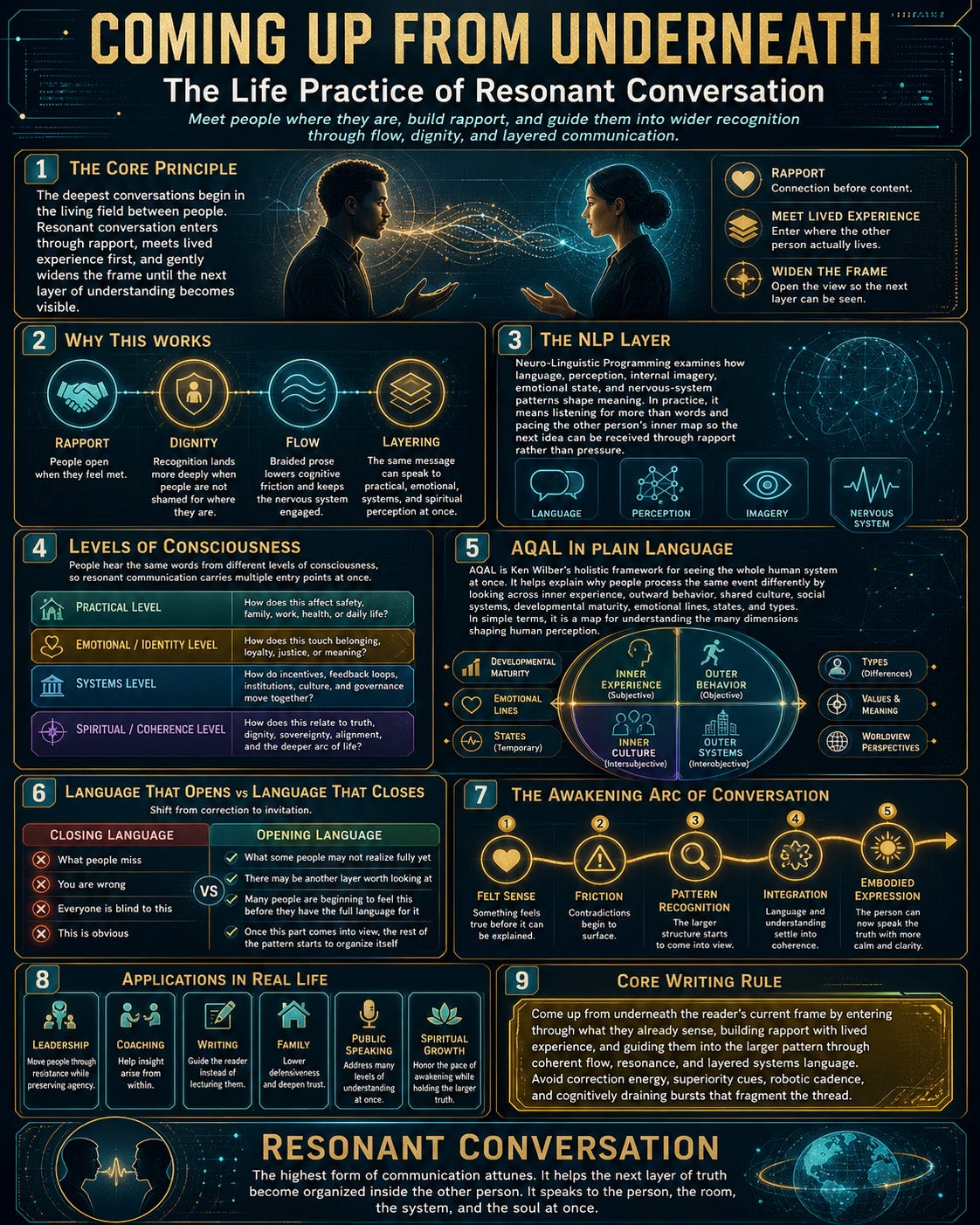
This matters because people listen from different levels of awareness. Some people are trying to understand how an idea affects their safety, family, job, finances, health, or daily life. Others are listening through identity, belonging, loyalty, morality, justice, or ideology. Others are beginning to hear the larger system, where incentives, feedback loops, institutions, culture, technology, economics, and governance all move together. Still others are sensing the spiritual architecture beneath the visible pattern, where coherence, inversion, sovereignty, God, truth, and human dignity become part of the same living field.
Resonant communication carries multiple layers at once. A person hearing from a practical level needs grounded language that touches real life. A person hearing from an emotional level needs to feel the human meaning inside the pattern. A person hearing from a systems level needs to see how the parts move together. A person hearing from a spiritual level needs language that honors the deeper arc while staying clear, embodied, and reachable. When the writing is tuned well, the same paragraph can meet all of them because it begins in lived experience, then gradually opens into structure, meaning, and alignment.
This is the real power of speaking across levels of consciousness. The practical reader sees the human example. The emotional reader feels the moral weight. The systems thinker recognizes the feedback loop. The spiritually attuned reader senses the restoration arc. Everyone receives from where they stand, and the conversation becomes a bridge that allows the whole room to move together through one shared current.
Flow is central to this because the nervous system receives rhythm before it fully processes meaning. Short-burst sentence stacks can create impact in the right moment, although too many clipped commands begin to create cognitive friction. The reader has to stop, reset, and restart, which makes the prose feel more like a ladder than a living current. Coherent writing braids actions, insights, and transitions into one continuous movement so the reader can remain inside the field of meaning long enough for the pattern to form.
This is why a line such as “you are wrong” closes the body, while “there may be another layer here worth looking at” keeps the body open. “Everyone is blind to this” creates separation, while “many people are beginning to feel this before they have the full language for it” creates belonging. “This is obvious” can shame the person still arriving, while “once this part comes into view, the rest of the pattern starts to organize itself” allows realization to emerge with dignity.
The awakening arc inside conversation begins when people feel something before they can explain it. Then they notice friction, begin sensing a pattern, receive language for what they have been carrying, integrate the lesson, and eventually speak the truth with less charge and more coherence. A resonant communicator understands that every person is somewhere on that arc, so the conversation becomes an act of attunement where the next true doorway opens from inside the person’s current field of readiness.
In leadership, this helps people move through resistance while preserving agency. In coaching, it helps someone discover their own insight. In writing, it lets the reader feel guided. In family conversations, it lowers defensiveness because the person feels seen before they are invited to see more. In public speaking, it allows a room full of different learning styles and consciousness levels to feel individually addressed while being moved through one collective current. In spiritual work, it honors the pace of awakening while still holding the larger truth.
The practice is simple in concept and demanding in embodiment. You listen beneath the words while sensing the readiness of the person in front of you, then you enter through the lived experience they already recognize and gently widen the frame in a way that preserves dignity, lowers resistance, and allows the next layer of understanding to rise without force. The rhythm matters because the sentence itself becomes part of the rapport. When the language moves in flow, the reader can stay with the signal long enough for the pattern to organize inside them.
This becomes a writing rule and a life rule. Come up from underneath the reader’s current frame by entering through what they already sense, building rapport with their lived experience, and guiding them into the larger pattern through flow, resonance, and layered systems language. The writing should avoid correction energy, superiority cues, robotic cadence, and cognitively draining bursts that fragment the thread. The prose should move as one coherent field of recognition, where each idea hands energy to the next and multiple levels of consciousness can receive the same truth at once.
The highest form of communication attunes. It helps the other person feel the next layer of truth becoming organized inside them. It speaks to the person, the room, the system, and the soul at once, and when it is done well, people walk away feeling as though they were reminded of something they already knew deep down and finally have the language to carry forward.
This is beautifully articulated. What stays with me most is the idea that good communication does not force recognition from above, but meets people where something is already beginning to form inside them. There is so much dignity in language that helps a person find words for what they have already sensed, without making them feel late, wrong, or less aware for not having named it sooner.
Good stuff OC. You make it sound so clear, and simple :-)
Easier said than done. It makes me appreciate all the more how Trump can talk to multiple audiences at the same time. I think all his TV work helped hone those skills.
Times are really intensifying... I am loving it!
God Wins!
God Bless!!!