
Propaganda Unveiled - Part 1
How Dark Techniques Control Consumer Behavior and Shape Minds in Academia

The 5 Monkeys Experiment - A Blueprint for Control
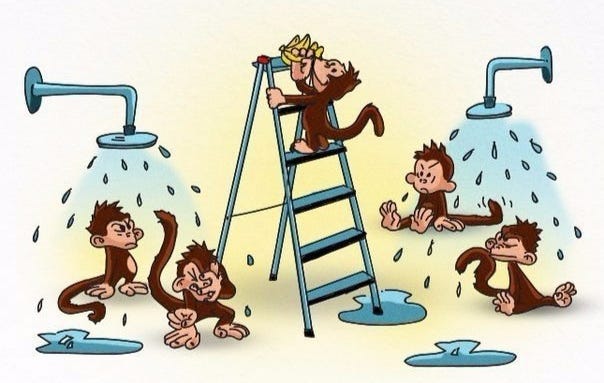
In a classic behavioral experiment, five monkeys were placed in a cage with a ladder in the center and bananas atop the ladder. Whenever a monkey attempted to climb the ladder, the experimenters would spray all the monkeys with icy water. Soon, each monkey learned to avoid the ladder to escape the chilling punishment. Eventually, the monkeys began to enforce this behavior amongst themselves, beating any monkey that tried to climb the ladder. Over time, the experimenters replaced each monkey one by one with new ones. Despite the new monkeys never experiencing the icy spray, they quickly conformed to the established social norm—beating any monkey attempting to climb the ladder. By the end, none of the original monkeys remained, yet the learned behavior persisted. The new monkeys continued to enforce a rule they did not understand, simply because "that's just how it's always been done."
Part 1: Recognizing the Manipulation
Step 1: Understanding Fear-Inducing Propaganda
The mechanisms of the 5 Monkeys Experiment can be seen in how dark propaganda techniques are used to manipulate consumer behavior, shape ideologies, and enforce governmental control. The CIA’s Gateway Experience and insights from MKUltra revealed much about how fear and manipulation can control behavior. Recognizing these techniques is the first step in the healing process.
Creating Anxiety and Scarcity
Much like the icy water in the monkey experiment, fear is used to manipulate consumer behavior. Advertisers create a sense of urgency and scarcity, making people anxious about missing out. Limited-time offers, fear of missing out (FOMO), and scare tactics about health and safety drive consumers to purchase products they might not otherwise consider.
In "Propaganda: The Formation of Men's Attitudes", Jacques Ellul notes, "Propaganda must be continuous and lasting—continuous in that it must not leave any gaps, but must fill the citizen's whole day and all his days" (Ellul, 1965). This reflects the continuous pressure applied through advertising to create anxiety and scarcity.
Enforcing Social Norms Through Fear
Social pressure ensures conformity. Just as the monkeys enforced the no-climbing rule, societal norms are reinforced through fear of social rejection or ridicule. Advertisements depict a desirable lifestyle that everyone should aspire to, creating an unspoken rule that deviation leads to social ostracism.
In Robert Cialdini's "Influence: The Psychology of Persuasion" explains, "The rule for reciprocation...is so deeply implanted in us by the process of socialization that it pervades our actions" (Cialdini, 1984). This highlights how deeply ingrained social norms compel conformity.
Sustaining Anxiety to Ensure Compliance
Fear-based propaganda perpetuates a cycle of anxiety and compliance. News outlets, social media, and advertisements continually present crises, health scares, and societal dangers, keeping the public in a state of constant vigilance and dependency on the marketed solutions.
Naomi Klein in "The Shock Doctrine: The Rise of Disaster Capitalism" argues, "In moments of crisis, people are willing to hand over a great deal of power to anyone who claims to have a magic cure" (Klein, 2007). This reflects how sustained anxiety ensures compliance.
Step 2: Recognizing Propaganda in Academia
Propaganda in academia works similarly, converting young minds with ideological fear.
Introducing Ideologies with a Fear-Based Narrative
Just as the ladder and bananas were introduced to the monkeys, ideological narratives are introduced in colleges through curricula and influential professors. These narratives often frame alternative viewpoints as dangerous or morally corrupt, instilling fear in students about questioning the dominant ideology.
Social Reinforcement Through Ostracism and Ridicule
Students learn quickly that challenging the prevailing ideology can lead to social isolation and academic penalties. This mirrors the monkeys' behavior of beating any peer attempting to climb the ladder. The fear of being ostracized or ridiculed enforces conformity.
Cultural Entrenchment of Fear-Based Ideologies
Over time, students internalize these fear-based ideologies, often without critically examining their validity. New students conform to these norms to fit in, perpetuating the cycle. The original reasons for the adoption of these ideologies are forgotten, replaced by a pervasive fear of stepping out of line. “It has always been done this way…”
Step 3: Identifying the Role of Cancel Culture
Cancel culture operates as a modern mechanism of social control, using fear and ostracism to enforce conformity. Individuals who express dissenting opinions or challenge the dominant narrative are publicly shamed, ostracized, and often professionally or socially ruined.
Public Shaming and Ostracism
Cancel culture leverages social media and public platforms to shame and isolate individuals. The fear of becoming a target of cancel culture enforces conformity, as people prefer to align with popular opinion rather than risk social annihilation.
"So You've Been Publicly Shamed", Jon Ronson explores the devastating effects of public shaming in the digital age, illustrating how fear of ostracism enforces social norms (Ronson, 2015).
Career and Social Consequences
The repercussions of being canceled extend beyond social circles, affecting careers and personal lives. This further reinforces the need for individuals to adhere strictly to the dominant narrative to avoid severe consequences.
In his book "The Madness of Crowds," Douglas Murray discusses how cancel culture imposes severe social and professional penalties, compelling strict adherence to dominant ideologies (Murray, 2019).
Step 4: The Science of Manipulation - Dark Triad Techniques
The Dark Triad… comprising Machiavellianism, narcissism, and psychopathy… provides a framework for understanding the psychological manipulation techniques employed in propaganda.

Machiavellianism
This involves the strategic manipulation and exploitation of others. Propagandists use Machiavellian tactics to craft narratives that exploit emotional vulnerabilities, creating fear and dependency. They manipulate public opinion to serve specific agendas, often through deceit and cunning strategies.
Narcissism
Narcissistic manipulation focuses on self-promotion and the creation of a grandiose image. Propaganda often portrays products, ideologies, or leaders in an excessively positive light, appealing to individuals' desires for status and superiority. This creates a compelling but misleading image that people aspire to, driving compliance and acceptance.
Psychopathy
Psychopathic traits involve a lack of empathy and remorse, coupled with boldness and manipulativeness. Propagandists employing psychopathic techniques exhibit a cold calculation in spreading fear and misinformation, indifferent to the psychological harm caused. They manipulate emotions to elicit desired responses, exploiting fear and insecurity to control behavior.
Step 5: Recognizing Governmental Use of Propaganda
Governments use propaganda to pressure the public into accepting diminishing human rights and more oppressive rules and regulations.
Instilling Fear of External Threats
Governments often highlight external threats… such as terrorism, pandemics, or foreign adversaries… to instill fear and justify the imposition of restrictive measures. This fear creates a compliant populace willing to sacrifice freedoms for perceived security.
George Orwell's "1984" is a seminal work illustrating how fear of external threats can be used to justify oppressive governmental control (Orwell, 1949).
Normalizing Oppression
Just as the monkeys accepted the no-climbing rule, citizens gradually accept oppressive regulations as normal. Continuous exposure to propaganda normalizes surveillance, censorship, and other erosions of civil liberties, making them seem necessary and justified. Such as masking, social distancing, lock-downs…
Suppressing Dissent Through Fear
Public shaming, legal consequences, and social ostracism are used to suppress dissent. Cancel culture extends to political and social spheres, where individuals who challenge government policies face severe backlash. This enforces conformity and discourages opposition. Mainstream media told us to shame “Uncle Joe” for not getting the vaccine during Christmas dinner…
Creating Dependency
Governments use propaganda to create dependency on state-provided solutions. By presenting themselves as protectors and problem-solvers, they foster a sense of reliance, reducing public resistance to increasing control and diminishing rights.
"Crisis and Leviathan", Robert Higgs discusses how governments expand their power during crises, creating dependency and reducing resistance to control (Higgs, 1987).
Step 6: Insights from the CIA’s Gateway Experience and MKUltra
The CIA's Gateway Experience and MKUltra experiments revealed deep insights into how fear and manipulation can control behavior.
Psychological Manipulation
Techniques to induce altered states of consciousness were studied to understand how to manipulate thoughts and perceptions. MKUltra specifically used methods like hypnosis, sensory deprivation, and the administration of psychoactive drugs to explore and exploit psychological vulnerabilities. These insights are used in propaganda to create messages that tap into deep-seated fears and anxieties.
Fear Conditioning
The experiments showed how fear could be conditioned and reinforced. MKUltra employed techniques such as repeated exposure to traumatic stimuli to condition subjects to respond to fear cues. Propaganda leverages this by repeatedly exposing the public to fear-inducing messages, creating a conditioned response that drives behavior.
Subliminal Messaging
Both the Gateway Experience and MKUltra explored subliminal messaging to influence thoughts without conscious awareness. MKUltra used subliminal audio and visual messages to see how they could alter behavior and perceptions. Modern propaganda uses similar techniques in advertisements, media, and political messaging to shape public opinion and behavior subtly.
"Subliminal: How Your Unconscious Mind Rules Your Behavior" by Leonard Mlodinow explores how subliminal messages influence behavior and decision-making, highlighting the power of unseen forces in propaganda (Mlodinow, 2012).
The Enduring Impact - The First Half of the Healing Cycle
By the end of this process… whether in consumer markets, academic settings, or governmental control… the behaviors and beliefs are so deeply entrenched that the original reasons for their adoption are forgotten. People continue to follow established norms because "that's just how it's always been done," unaware of the initial manipulative forces that set these behaviors in motion.
Understanding these dark propaganda techniques is crucial for recognizing and resisting their influence, allowing individuals to make more informed choices and fostering a more critically aware society. Just as the monkeys in the experiment perpetuated a behavior without understanding its origin, we must strive to question the norms and beliefs imposed upon us, ensuring they align with our values and reasoned judgment.
Coming Soon: Part 2 – Completing the Healing Cycle
This article is the first half of the journey around the infinity cycle of healing. In Part 2, we will explore the logical steps needed to fully realize the scope of manipulation by the government and large companies, and how to heal from these realizations. By understanding and dismantling the structures of manipulation, we can complete the healing process and emerge more aware and empowered. Stay tuned for Part 2, where we will delve into the methods to finish the healing cycle.