
The Fraud Industrial Complex - The System
The Living Architecture Beneath the Scandals

There is a moment in every serious investigation when the scale changes and the stories that once appeared separate begin revealing the same internal design.
A nutrition program in Minnesota, billions flowing through homelessness systems in California, pandemic loans created from manufactured applications, Medicare claims attached to patients who never received the billed care, and federal grants passing through layers of sponsors, contractors, nonprofits, and local partners begin to look less like isolated failures and more like expressions of one repeated architecture.
The programs differ, the institutions differ, and the money moves through different laws, agencies, accounts, and professional systems. The deeper movement remains remarkably consistent.
A real human need creates moral urgency. Government converts that urgency into authority, eligibility, and funding. An institution receives trust. Identity opens access. Records describe what supposedly occurred, and those records authorize payment. The money then leaves public control before the entire chain can determine whether the identity, service, owner, vendor, and human outcome belong to the same reality.
By the time investigators arrive, public money has often changed form. It has become property, payroll, vehicles, investments, consulting fees, related-party contracts, international transfers, institutional expansion, political influence, and legal protection. The public program records an expenditure while the operating network receives durable capital.
This is where scandal gives way to architecture…
The Fraud Industrial Complex is the living system formed wherever human need, institutional trust, administrative records, and public payment become separated across organizations that each hold only part of the truth. It grows through ordinary handoffs where responsibility becomes thinner while authority and money continue moving.
No central headquarters is required. The architecture emerges through incentives, distance, fragmented visibility, and the repeated ability to convert administrative credibility into financial value.
The public sees organizations and individual transactions. The deeper movement occurs through relationships, repeated functions, control points, payment channels, and the spaces between institutions.
Human Need Enters an Administrative World
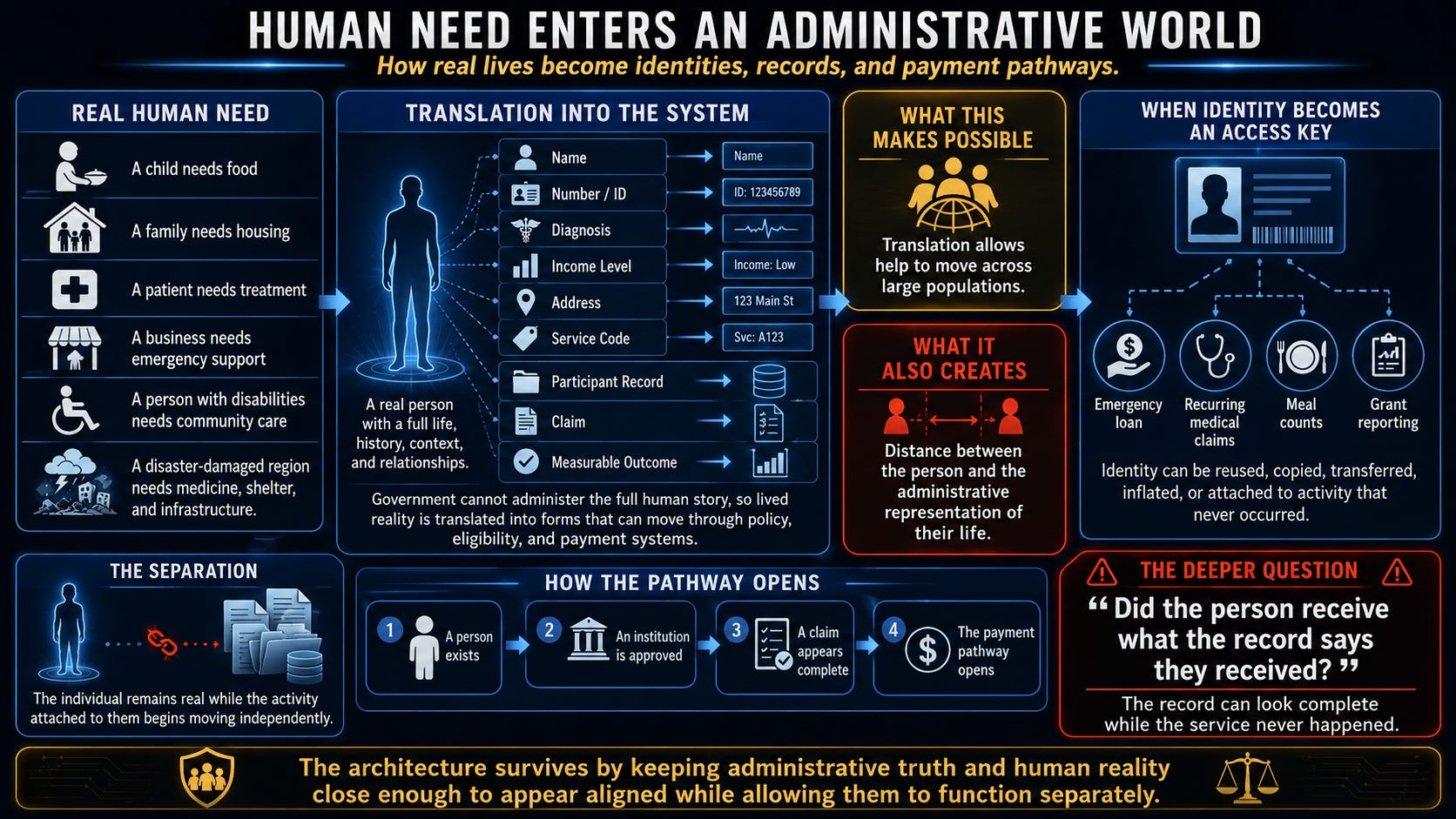
Every public program begins with someone whose need is real.
A child needs food. A family needs housing. A patient needs treatment. A business needs emergency support. A person with disabilities needs care inside the community. A region damaged by war or disaster needs medicine, shelter, and infrastructure.
Government cannot administer the full human story, so it translates lived reality into forms that can move through policy, eligibility, and payment systems. A person becomes a name, number, diagnosis, income level, address, service code, participant record, claim, or measurable outcome.
That translation allows help to move across large populations. It also creates distance between the person and the administrative representation of their life.
Once identity becomes an access key, it can be reused, copied, transferred, inflated, or attached to activity that never occurred. A Social Security number can open an emergency loan. A patient identity can support recurring medical claims. A child’s name can appear inside meal counts. A beneficiary can remain active inside a grant report while receiving little of what was promised in their name.
The individual remains real while the activity attached to them begins moving independently.
This separation carries enormous financial power because public systems often trust the administrative record long before they can verify the physical event. A person exists, an institution is approved, a claim appears complete, and the payment pathway opens.
The deeper question arrives later.
Did the person receive what the record says they received?
That question sits at the center of the Fraud Industrial Complex because the architecture survives by keeping administrative truth and human reality close enough to appear aligned while allowing them to function separately.
The record can look complete while the service never happened.
Trust Becomes a Transferable Asset
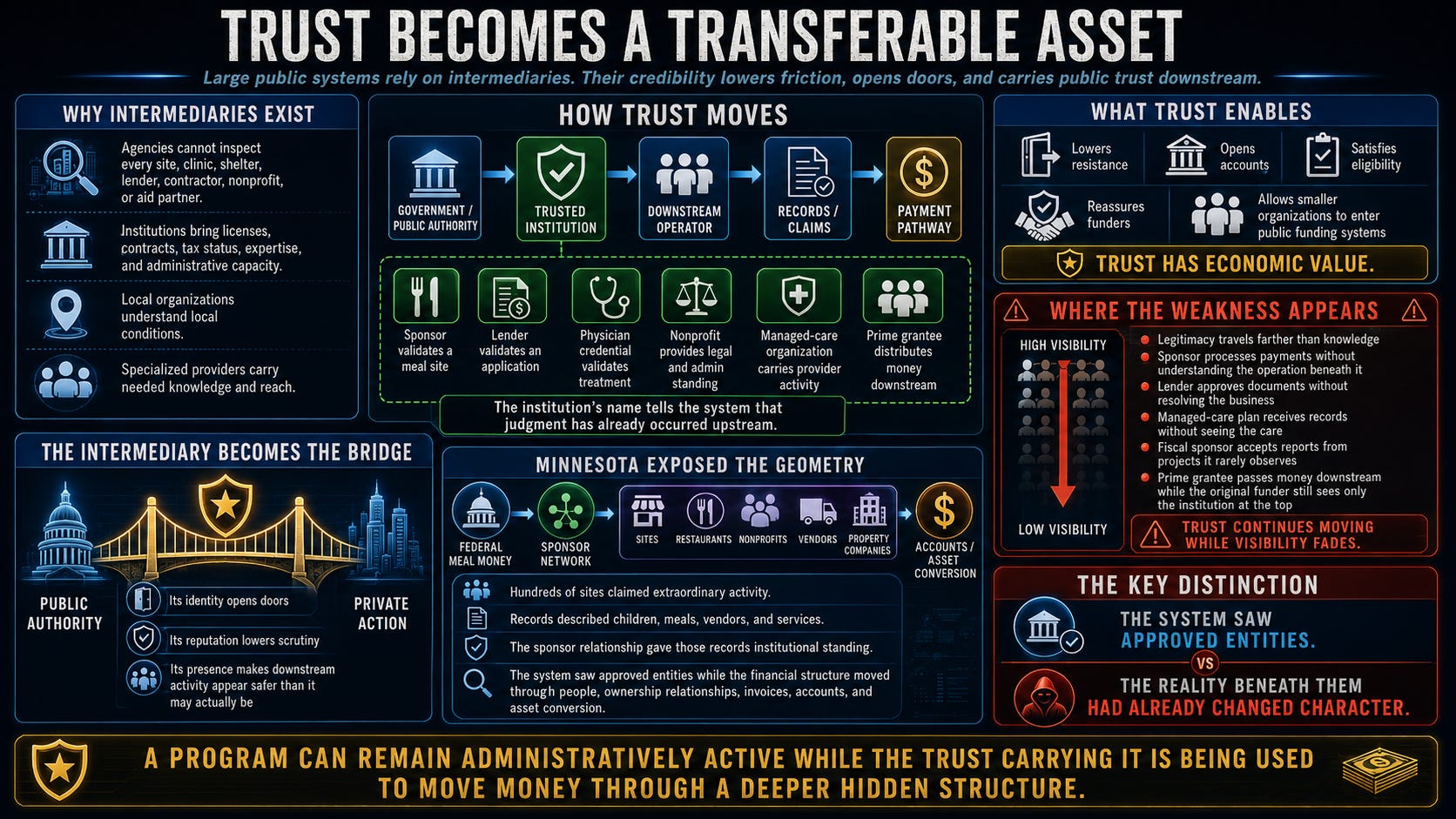
Large public systems depend upon intermediaries because agencies cannot personally inspect every meal site, clinic, shelter, housing provider, research project, lender, contractor, nonprofit, or local aid organization. They rely upon institutions with licenses, contracts, tax status, grant history, professional expertise, audited statements, and established government relationships.
Those institutions carry trust into the transaction.
A sponsor validates a meal site. A lender validates an application. A physician credential validates treatment. A nonprofit provides legal and administrative standing to a project. A managed-care organization carries provider activity into a public reimbursement system. A prime grantee distributes money toward organizations closer to the ground.
The institution’s name tells the government that judgment has already occurred somewhere upstream.
That trust has economic value because it lowers resistance. It opens accounts, satisfies eligibility, reassures funders, and allows smaller organizations to enter public funding systems beneath the credibility of larger ones.
This structure can serve an important purpose. Local organizations understand local conditions. Small projects need administrative support. Specialized providers bring knowledge and capacity that centralized agencies cannot reproduce.
The weakness appears when institutional legitimacy travels farther than institutional knowledge.
A sponsor processes payments while barely understanding the operation beneath it. A lender approves applications without resolving the business behind the documents. A managed-care plan receives encounter records without seeing the care. A fiscal sponsor accepts reports from projects it rarely observes. A prime grantee passes money downstream while the original funder continues seeing only the institution at the top.
Trust continues moving while visibility fades.
The intermediary has now become more than an administrator. It has become the bridge between public authority and private action. Its identity opens doors, its reputation lowers scrutiny, and its presence makes the downstream network appear safer than it may actually be.
Minnesota’s nutrition scandal exposed this geometry in plain sight. Federal meal money moved through a sponsor network that allowed hundreds of sites to claim extraordinary activity. Restaurants, nonprofits, vendors, property companies, and related entities formed around the expanding flow. Records described children, meals, vendors, and services, while the sponsor relationship gave those records institutional standing.
The system saw approved entities. The financial structure moved through people, ownership relationships, invoices, accounts, and asset conversion.
That distinction explains how a program can remain administratively active while the reality beneath it has already changed character.
Records Become Money
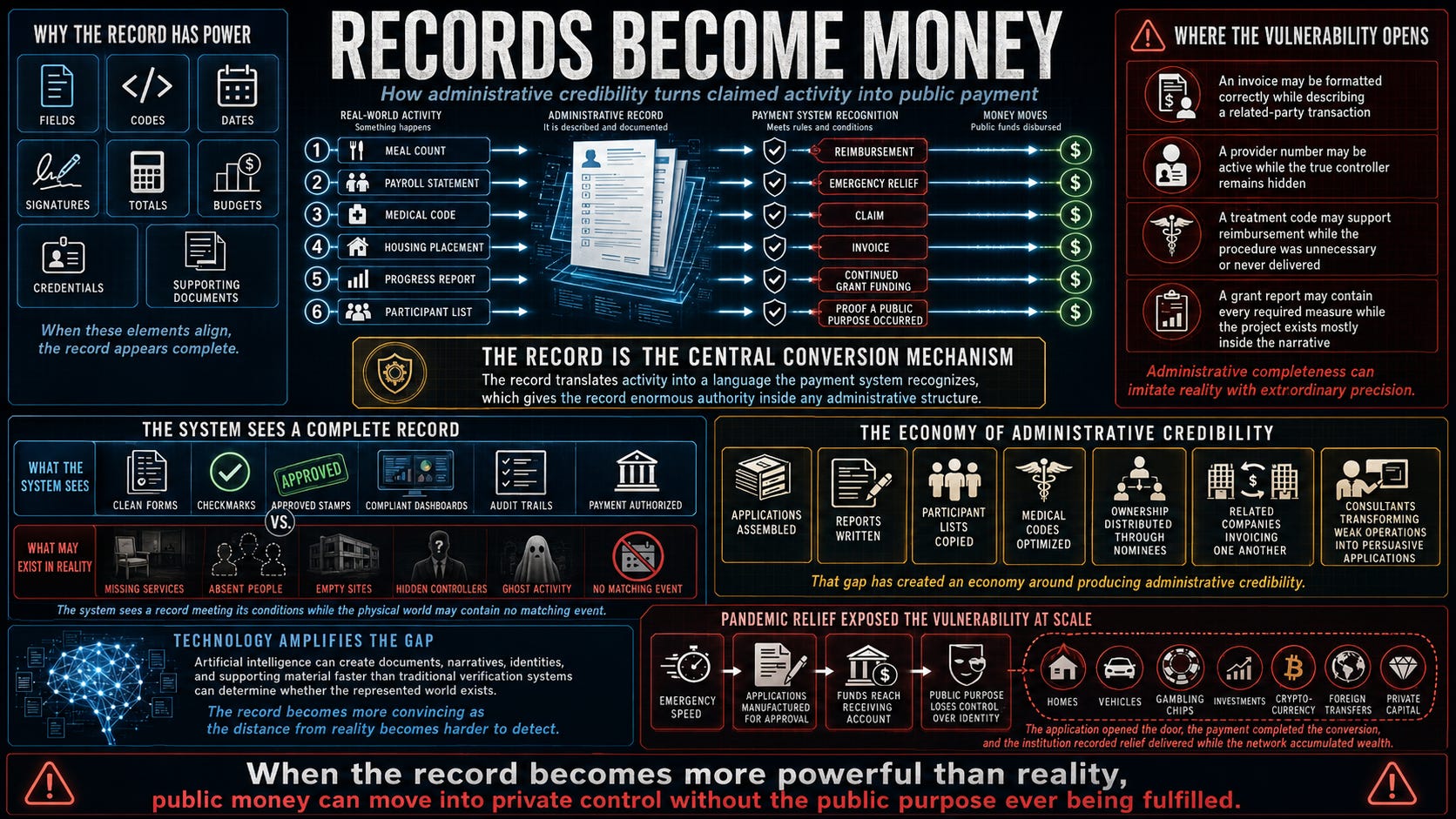
The record is the central conversion mechanism.
A meal count becomes reimbursement. A payroll statement becomes emergency relief. A medical code becomes a claim. A housing placement becomes an invoice. A progress report becomes continued grant funding. A participant list becomes proof that a public purpose occurred.
The record translates activity into a language the payment system recognizes, which gives the record enormous authority inside any administrative structure.
That authority creates a deep vulnerability.
Public systems are designed to determine whether a submission satisfies known requirements. They examine fields, codes, dates, signatures, totals, budgets, credentials, and supporting documents. When those elements align, the record appears complete.
Administrative completeness can imitate reality with extraordinary precision.
An invoice may be formatted correctly while describing a related-party transaction. A provider number may be active while the true controller remains hidden. A treatment code may support reimbursement while the procedure was unnecessary or never delivered. A grant report may contain every required measure while the project exists mostly inside the narrative.
The system sees a record meeting its conditions while the physical world may contain no matching event.
That gap has created an economy around producing administrative credibility. Applications can be assembled, reports can be written, participant lists can be copied, medical codes can be optimized, ownership can be distributed through nominees, and related companies can invoice one another. Consultants can transform a weak operation into a persuasive application without changing the reality beneath it.
Technology increases this capacity because artificial intelligence can create documents, narratives, identities, and supporting material faster than traditional verification systems can determine whether the represented world exists.
The record becomes more convincing as the distance from reality becomes harder to detect.
Pandemic relief revealed this vulnerability at national scale. Emergency programs were built to move money quickly because businesses were collapsing and families needed economic protection. That speed preserved legitimate companies and workers, while also creating an operating environment where applications could become products manufactured for approval.
Once the funds reached the receiving account, the public purpose lost control over their identity. Relief money became homes, vehicles, gambling funds, investments, cryptocurrency, foreign transfers, and private capital.
The application opened the door, the payment completed the conversion, and the institution recorded relief delivered while the network accumulated wealth.
The Response Develops Roots
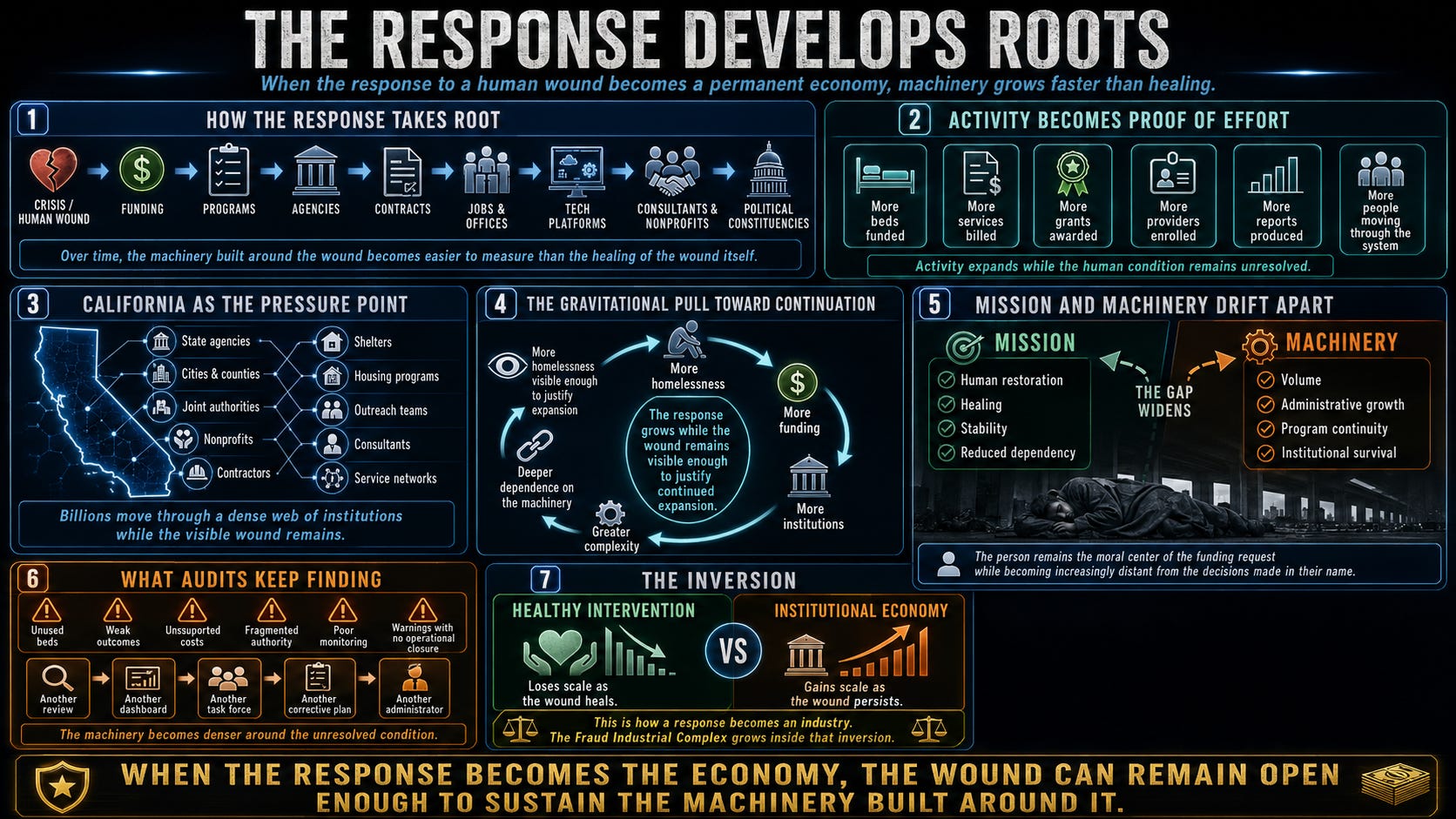
The architecture becomes more durable when the response to a human wound develops its own permanent economy.
A crisis creates funding, funding creates programs, and programs create agencies, contracts, jobs, offices, technology platforms, consultants, nonprofits, professional roles, and political constituencies. Over time, the machinery built around the wound becomes easier to measure than the healing of the wound itself.
More beds are funded, more services are billed, more grants are awarded, more providers are enrolled, more reports are produced, and more people move through the administrative system.
Activity becomes proof of effort while the human condition remains unresolved.
California’s homelessness apparatus reflects this pressure. Billions have moved through state agencies, cities, counties, joint authorities, nonprofits, contractors, shelters, housing programs, outreach teams, consultants, and service networks. Many people inside those institutions are trying to help under conditions carrying enormous human complexity.
The structure still develops a gravitational pull toward continuation.
More homelessness produces more funding. More funding produces more institutions. More institutions create greater complexity, and greater complexity creates deeper dependence upon organizations capable of navigating the machinery already in place.
The response grows while the wound remains visible enough to justify continued expansion.
This dynamic does not require widespread malicious intent because the structure itself shapes behavior. An organization paid for activity benefits from greater activity. A provider paid per service benefits from volume. A contractor managing crisis conditions gains institutional value from remaining necessary.
Mission and machinery begin drifting apart.
The person sleeping beneath the freeway remains the moral center of the funding request while becoming increasingly distant from the decisions made in their name.
Audits identify unused beds, weak outcomes, unsupported costs, fragmented authority, poor monitoring, and warnings that moved through several offices without producing operational closure. The response then creates another layer around the unresolved condition through another review, another dashboard, another task force, another corrective plan, or another administrator.
The machinery becomes denser.
This is how a response becomes an industry.
A healthy intervention loses scale as the wound heals. An institutional economy gains scale as the wound persists.
The Fraud Industrial Complex grows inside that inversion.
The Body Becomes the Billing Surface
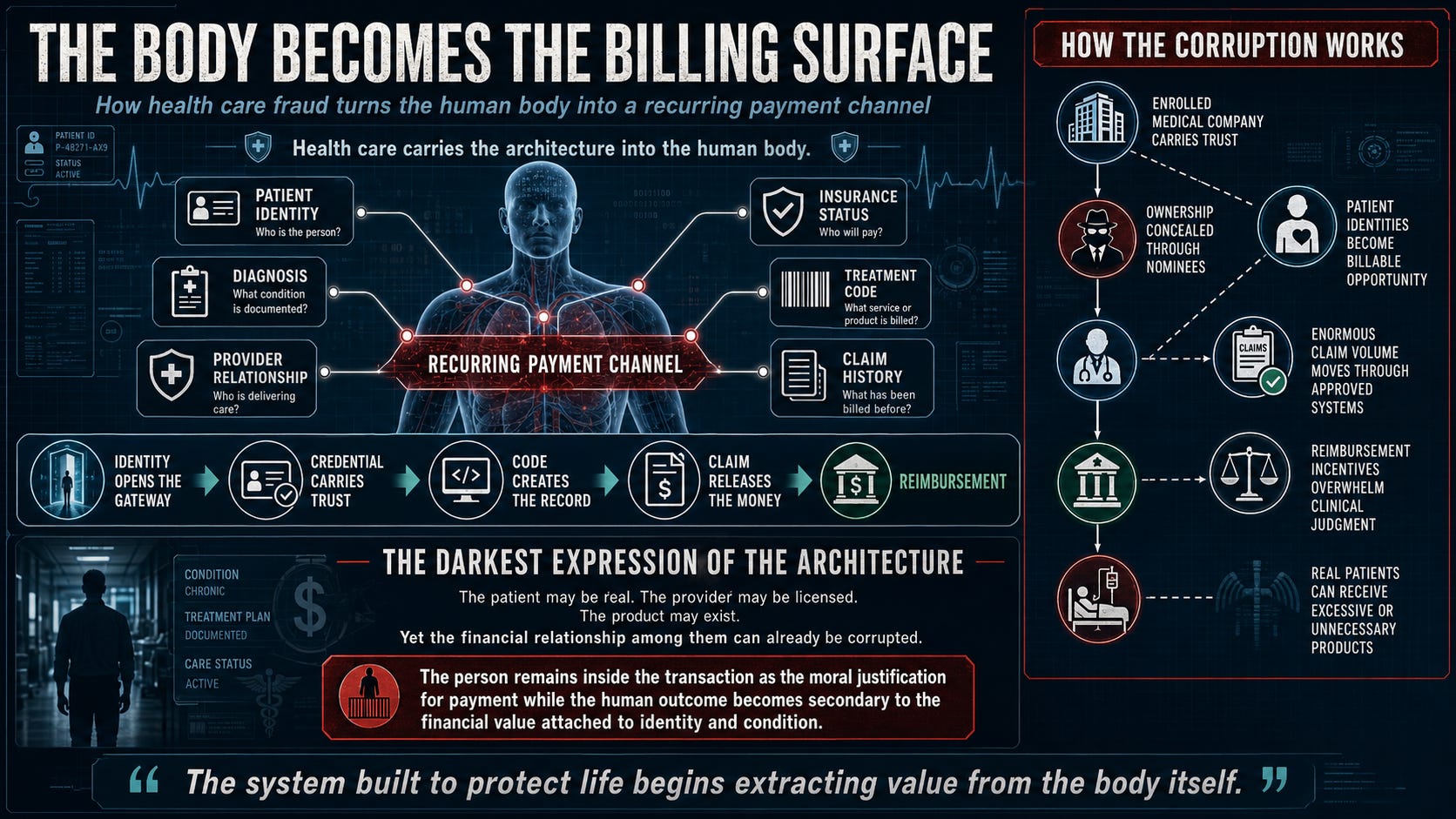
Health care carries the architecture into the human body.
A patient’s identity, diagnosis, provider relationship, insurance status, treatment code, and claim history create a recurring payment channel. The patient may be real, the provider may be licensed, and the product may exist while the financial relationship among them has already become corrupted.
An enrolled medical company carries trust. A credential opens access. Patient identities create billable opportunity. Codes translate treatment into reimbursement, and the payment system responds to the claim.
The body becomes a surface upon which value can be generated.
Large health-care schemes have shown how enrolled companies can be acquired, ownership concealed through nominees, patient identities obtained, and enormous volumes of claims submitted through organizations already connected to federal payment systems.
Other cases show real patients receiving excessive or unnecessary products because reimbursement incentives overwhelmed clinical judgment.
The person remains inside the transaction as the moral justification for payment while their human outcome becomes secondary to the financial value attached to their identity and condition.
This is the darkest expression of the architecture because the system built to protect life begins extracting value from the body itself.
Identity opens the gateway, the credential carries trust, the code creates the record, and the claim releases the money while the patient disappears inside the administrative representation of care.
Fragmentation Protects the Pattern
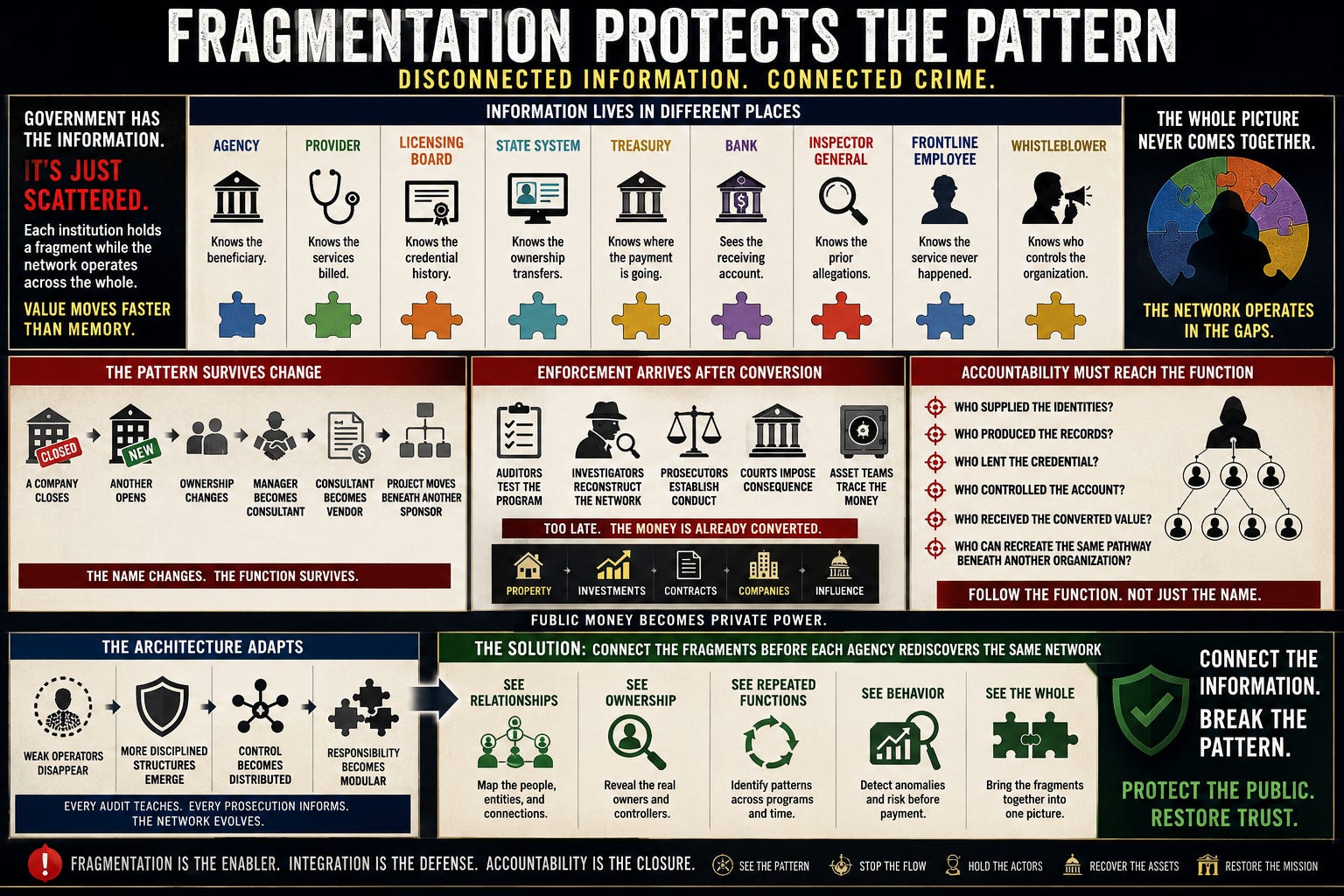
Government already holds nearly every piece of information required to see these networks, yet the information lives in different places.
One agency knows the beneficiary. Another knows the provider. A licensing board knows the credential history. A state system knows the ownership transfer. Treasury knows where the payment is going. A bank sees the receiving account. An inspector general knows the prior allegation. A frontline employee knows the service never happened. A whistleblower knows who controls the organization.
Each institution holds a fragment while the network operates across the whole. This allows financial value to move faster than institutional memory.
A company closes and another opens. A provider changes ownership. A nonprofit creates a related entity. A manager becomes a consultant, a consultant becomes a vendor, and a project moves beneath another sponsor.
The visible name changes while the operating function survives.
Traditional enforcement arrives after conversion. Auditors test the program, investigators reconstruct the network, prosecutors establish conduct, courts impose consequence, and asset teams trace money after it has become property, investments, contracts, companies, and influence.
Public money has already become private power.
Enforcement still matters because accountability must reach the people responsible. Prosecution alone cannot correct a structure that continues producing the same opportunity through new names.
The system has to remember the function. Who supplied the identities? Who produced the records? Who lent the credential? Who controlled the account? Who received the converted value? Who can recreate the same pathway beneath another organization?
The architecture adapts because every audit and prosecution teaches the network where government is looking. Weak operators disappear, more disciplined structures emerge, control becomes distributed, and responsibility becomes modular.
Government has to learn at the same level by seeing relationships, ownership, repeated functions, and behavior across programs before each agency is forced to rediscover the same network independently.
The Defense Grid Begins to Form
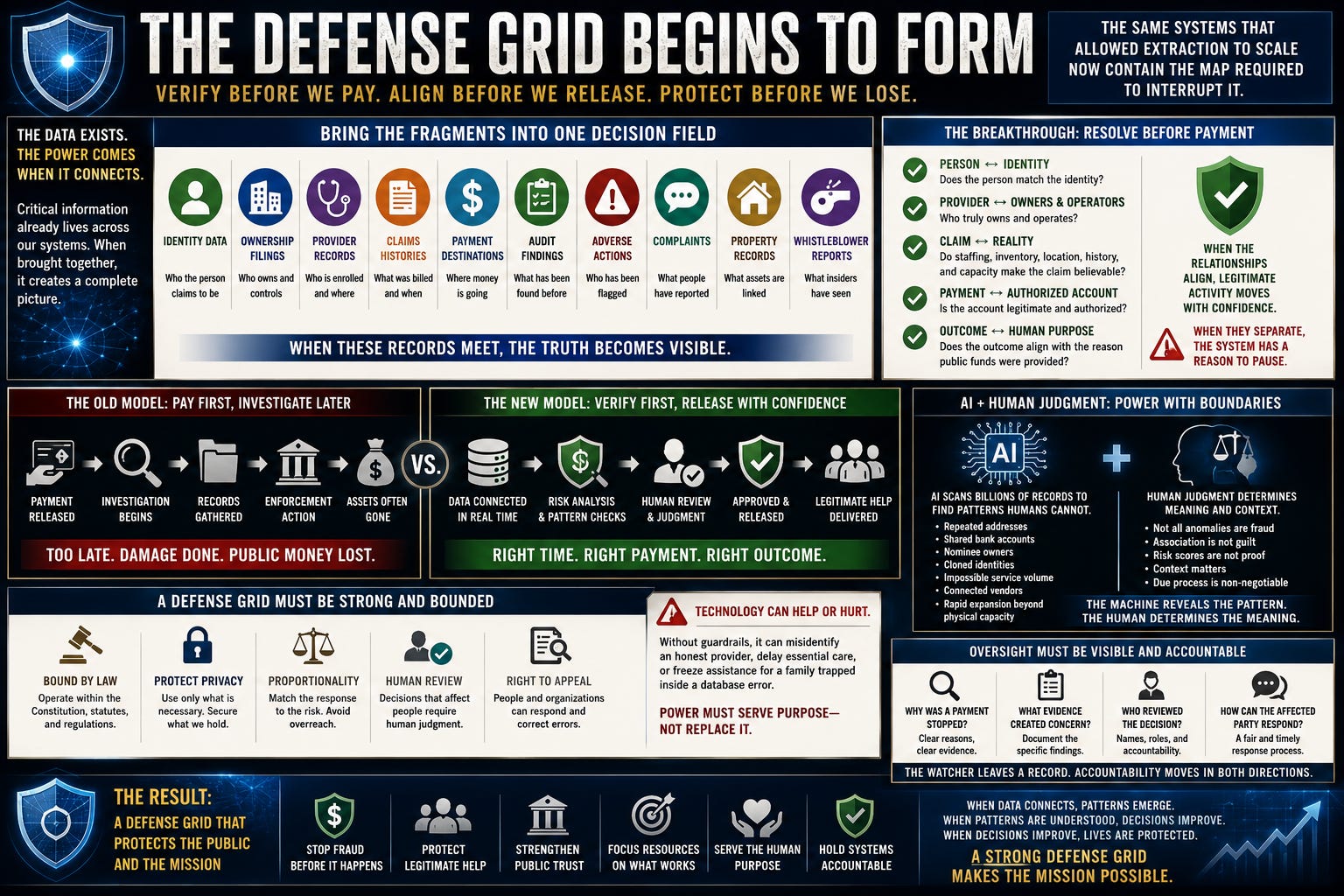
The same systems that allowed extraction to scale now contain the map required to interrupt it.
Identity data, ownership filings, provider records, claims histories, payment destinations, audit findings, adverse actions, complaints, property records, and whistleblower reports can meet inside the same decision field.
The breakthrough comes when those records resolve before payment.
A person resolves with the identity. A provider resolves with its true owners and operators. A claim resolves with believable staffing, inventory, geography, treatment history, and physical capacity. A payment resolves with an authorized account. The outcome resolves with the human purpose that justified the money.
When those relationships align, legitimate activity moves with greater confidence. When they separate, the system gains a reason to pause.
This changes the sequence from payment followed by investigation toward verification before release.
Artificial intelligence can compare billions of records and reveal repeated addresses, shared accounts, nominee owners, cloned identities, impossible service volume, connected vendors, and rapid expansion beyond physical capacity.
The machine reveals the pattern while human judgment determines meaning.
That boundary protects freedom because association cannot become guilt, an anomaly cannot become proof, and a risk score cannot replace due process.
A defense grid capable of stopping fraud at scale must remain bounded by law, privacy, proportionality, human review, and appeal. The same technology capable of exposing a hidden network can misidentify an honest provider, delay essential care, or freeze assistance for a family trapped inside a database error.
The system exercising oversight must remain visible too.
Government should be able to explain why a payment was stopped, what evidence created concern, who reviewed the decision, and how the affected person or institution can respond.
The watcher leaves a record, allowing accountability to move in both directions.
The Mission Must Survive the Intermediary
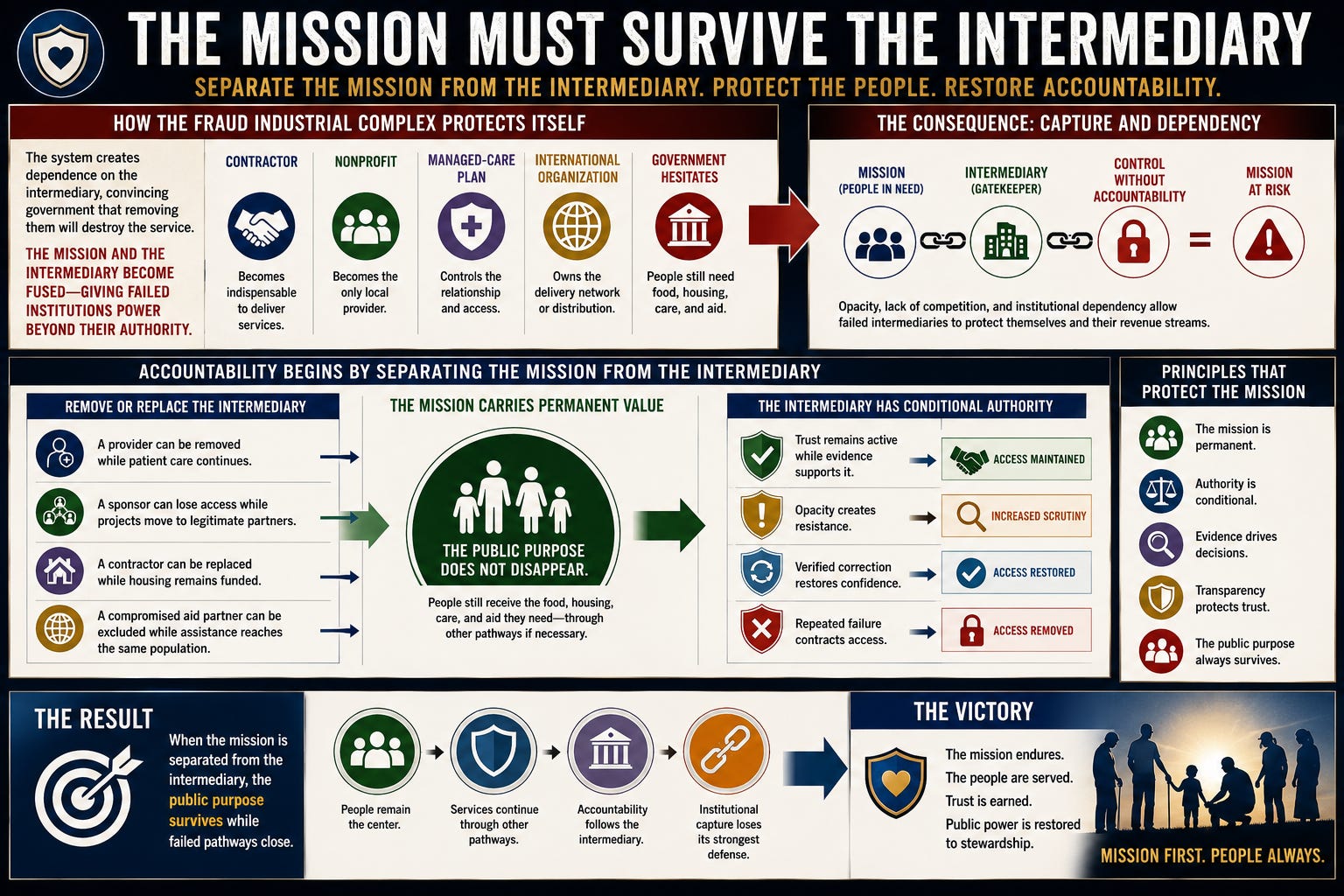
The Fraud Industrial Complex protects itself through the belief that removing the institution will destroy the service.
A contractor becomes indispensable, a nonprofit becomes the only local provider, a managed-care plan controls the relationship, or an international organization owns the delivery network. Government hesitates because people still need food, housing, care, and aid.
The mission and the intermediary become fused, giving failed institutions power beyond their formal authority.
Accountability begins by separating them.
A provider can be removed while patient care continues. A sponsor can lose access while legitimate projects move elsewhere. A contractor can be replaced while housing remains funded. A compromised aid partner can be excluded while assistance reaches the same population through another pathway.
The mission carries permanent value while the intermediary carries conditional authority.
Trust remains active while evidence supports it. Opacity creates resistance. Verified correction restores confidence. Repeated failure contracts access.
The public purpose survives while the failed pathway closes.
This is how institutional capture begins losing its strongest defense.
A Healthy System Makes the Wound Smaller
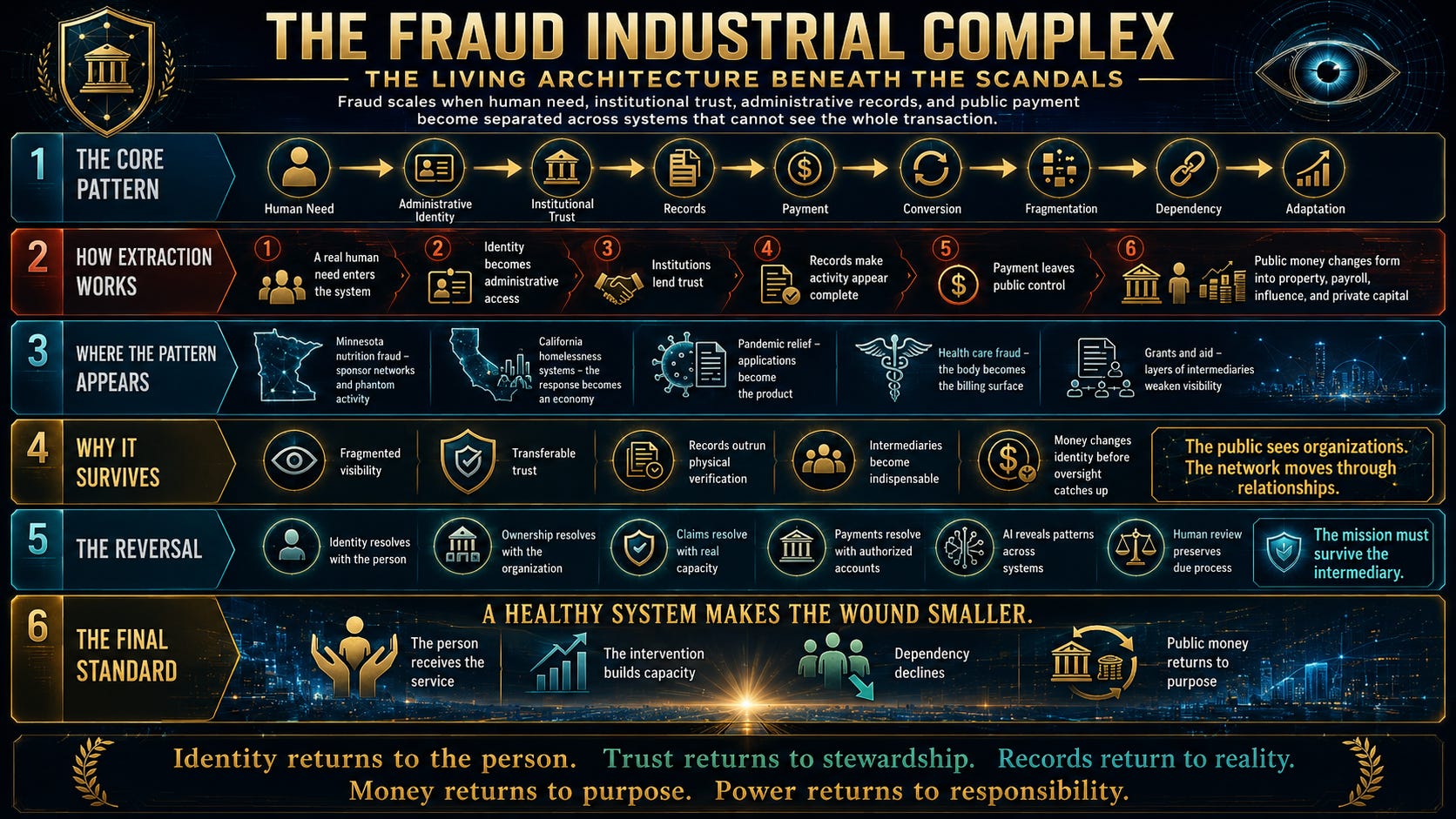
Stopping fraud protects public value. Restoration reveals whether the mission succeeded.
A program can account for every dollar while the original condition continues expanding. A shelter system can fill every bed while homelessness grows. A medical program can verify every claim while health outcomes decline. A grant network can document every expense while the community remains dependent.
The final receipt is the human outcome…
Did the family remain housed? Did the patient improve? Did the business survive? Did the child gain function? Did the community become stronger? Did the person retain the benefit delivered in their name? Did the institution become less necessary because human capacity increased?
These questions reveal whether the response is healing the wound or building an economy around it.
A healthy system expands during crisis, concentrates resources around the need, verifies that the intervention works, and then transfers capacity outward as stability returns.
Need creates support, support builds capacity, and capacity reduces need. The machinery becomes lighter because life becomes stronger.
The Fraud Industrial Complex reverses this movement by allowing need to create machinery, machinery to create dependency, and dependency to protect the machinery. The wound remains open enough to sustain the economy built around it.
Once the pattern becomes visible, the public is no longer trapped inside it.
We can follow the movement from identity to trust, from trust to records, from records to payment, from payment to conversion, and from conversion to institutional power. We can ask who created the identity, who verified eligibility, who lent the trust, who produced the record, who authorized the payment, who controlled the organization, where the money settled, and whether the human outcome matched the public claim.
Those questions bring the fragments into one field, separating legitimate complexity from concealment, distinguishing honest institutions from administrative shells, and allowing government to close a failed pathway while preserving the mission.
They return trust to stewardship…
The scandals were never isolated. They were fragments of a system that learned how to turn human need into transferable administrative value while accountability dissolved across institutions.
That system is beginning to see itself…
Records are connecting, payments can be stopped before release, credentials can carry history, ownership can become harder to hide, intermediaries can be required to produce evidence, and assets can be traced after conversion.
The architecture can reverse. The moral center remains the person.
Identity belongs to them. Public money belongs to the mission. Authority belongs to responsibility. Technology belongs beneath human judgment. Institutions exist to make the wound smaller.
The Fraud Industrial Complex grew through thousands of ordinary handoffs where trust continued moving while accountability became thinner. Its dismantling begins through thousands of handoffs where responsibility remains attached.
The sponsor verifies the project, the provider protects the patient, the lender resolves the applicant, the agency sees the owner, the bank understands the controller, the analyst connects the records, the investigator follows the money, the court preserves due process, and the public remembers the person whose need gave the entire structure its moral authority.
Identity returns to the person, trust returns to stewardship, records return to reality, money returns to purpose, and power returns to responsibility.
The machinery begins serving life again as the wound becomes smaller, the person becomes stronger, and the system remembers why it exists.
We are heading into system that serves humanity… enjoy the ride…
- OC
my eyes were opened to this process on 9/11. the orchestration of all the liars, agents, actors, engineers, heroes was like nothing i'd ever seen before. giant efficient and skilled networks were steered into committing a giant terrible criminal event. the movie "operation terror" (2012) captures this phenomena well. the massive fraud we see today in social programs, based in man's need to help those in need, has a similar structure. people make the best with what they've got, and if they have an in to money networks they would be fools not to go in and grab some money. Q - why do you rob banks? A - that's where the money is. as we know now banks don't have money. money is based in contracts, and the social contract is the biggest contract of them all. perhaps the social contract's face value is infinity.
Nice! “”A system that serves humanity” ❤️
Covid and the Biden open boarders created a light at the end of a dark tunnel …and that Light grows brighter and brighter!