
The National Replication
How the Minnesota Fraud Template Became a Portable System

This is a follow-up article to my piece below… I’d suggest reading that first.

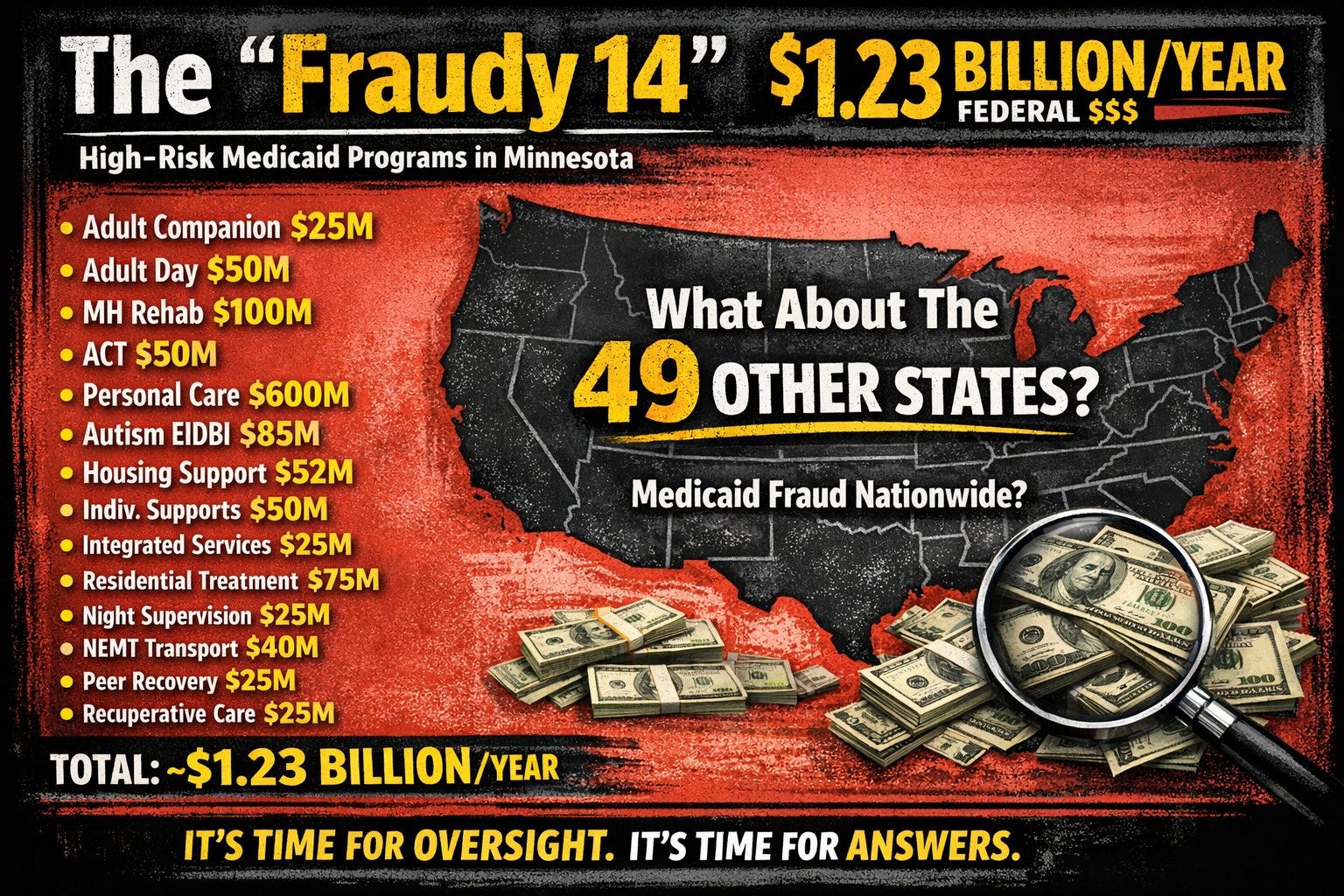
Minnesota did not close when the prosecutions landed, it broke wide open...
What federal authorities exposed inside the state was not a one-off collapse. It was a working model. Once that model became visible in court records, indictments, and convictions, it became exportable. The value of Minnesota was never limited to the scale of the theft. Its value was structural. It showed how industrial fraud forms inside permissive systems, how it survives early warning, and how it migrates when pressure is finally applied.
That is why the Minnesota cases did not end at state borders, they propagated.
What began as a contained demonstration inside one jurisdiction now functions as a national signal. The same patterns are surfacing in other states, not because Minnesota inspired imitation, but because it revealed the underlying mechanics. Once those mechanics are understood, repetition becomes predictable.
Minnesota was the proof case. The rest of the country is the replication phase.
From exposure to export…
Inside Minnesota, the fraud stack did not collapse all at once, it layered.
The first layer formed in child nutrition under pandemic emergency authorities. The second appeared in Medicaid housing programs. The third followed in autism and behavioral health. A fourth emerged in child care assistance. Each layer reused the same administrative gates. Each operated after warning. Each continued because enforcement lagged behind payment.
That sequencing mattered. Fraud was not discovered and stopped. It was discovered, tolerated, and then reused.
Once the Feeding Our Future prosecutions removed any ambiguity about intent or method, the continuation of similar billing patterns elsewhere in the state hardened the template. At that point, Minnesota was no longer simply experiencing fraud. It was demonstrating how fraud persists when systems absorb warning without interruption.
That demonstration did not stay local.
The internal stack that made replication possible…
The foundation was laid under child nutrition programs administered through the Minnesota Department of Education. Under emergency USDA rules, nonprofit sponsors were granted broad authority to validate sites and aggregate claims. That authority replaced physical verification with paperwork. It was meant to accelerate service delivery. It instead created a single choke point that could be exploited at scale.
Feeding Our Future, led by Aimee Bock, occupied that choke point. Hundreds of meal sites were approved. Federal indictments later showed that many sites were empty buildings, private apartments, or locations that never served food at all. Meal counts exceeded any plausible demand. Rosters listed children who did not exist. Documentation was duplicated across unrelated locations.
Warnings entered the system early. State officials flagged implausible claims while payments were ongoing. Rather than suspension, reviews began. When the nonprofit sued the state alleging discrimination, enforcement slowed further. Payments continued. By the time federal prosecutors intervened, losses exceeded a quarter billion dollars. More than seventy defendants were charged. Over sixty were convicted. Funds were traced into real estate, vehicles, cash withdrawals, and overseas transfers. Salim Said emerged as a central laundering figure.
At that point, the mechanics were no longer theoretical. They were established in court.
What followed was the signal…
Housing Stabilization Services, a Medicaid program launched in 2020 and administered by the Minnesota Department of Human Services, began to exhibit the same characteristics. Providers enrolled rapidly. Claims volume spiked. Services billed could not be verified. Addresses did not align. Documentation recycled. Federal indictments later named defendants including Moktar Hassan Aden and Mustafa Dayib Ali. The billing patterns mirrored the nutrition fraud almost exactly.
Then autism and behavioral health programs followed, particularly Early Intensive Developmental and Behavioral Intervention. Spending exploded from negligible levels to hundreds of millions annually. Federal cases later detailed fabricated therapy hours, recruited children used primarily for billing, and kickbacks to parents. Defendants included Asha Hassan of Smart Therapy LLC and Abdinajib Yussuf of Star Autism. Again, overlapping addresses, shared personnel, and identical billing structures appeared.
By the time child care assistance schemes surfaced and FBI raids expanded across the Twin Cities, Minnesota’s losses were estimated near nine billion dollars. Fragmented payment rails allowed billing to continue even as scrutiny increased. Pressure did not stop the flow. It redirected it.
This internal reuse is what made the template portable.
Migration, not coincidence…
When enforcement finally tightened in Minnesota, activity did not vanish, it moved.
Federal investigators began seeing the same organizational structures, the same sponsor models, and the same billing behaviors appear in other states with similar administrative tolerances and resettlement infrastructure. This was not ideological spread. It was operational migration.
In Maine, entities tied to Minnesota networks established organizations such as Gateway Community Services, exploiting housing and social service grants through inflated claims and shell structures. Millions were lost before funding was halted. Personnel overlaps and remittance patterns matched Minnesota cases. Federal probes have treated these as exported models, not independent schemes.
Washington saw similar ripples. FBI scrutiny of Minnesota day care fraud extended into Somali communities around Seattle. Allegations of ghost enrollments and subsidy abuse triggered audits across HUD and Medicaid programs. The billing mechanics mirrored Minnesota’s earlier phases, even as cases remain active.
Michigan followed the same arc. In Detroit-area Somali communities, Medicaid autism and housing claims spiked sharply. Investigators identified kickbacks, fabricated services, and shell providers. Family and business ties linked operators back to Minnesota defendants. Losses in the tens of millions remain under investigation.
New York has increasingly been described by investigators as the next major node. Somali-led nonprofits in New York City replicated sponsor-based nutrition and housing models. Statewide freezes and audits were informed directly by Minnesota’s experience. Medicaid exposure is now measured in the hundreds of millions.
California presents the largest surface area. In Los Angeles and San Diego, Somali networks exploited pandemic-era expansions in nutrition and housing programs using structures nearly identical to Feeding Our Future. Federal terrorism-financing warnings have accompanied several cases, echoing language first used in Minnesota filings.
Ohio, Texas, and Virginia are now appearing in federal briefings as emerging replication sites. The pattern remains consistent. Once Minnesota enforcement tightened, operators migrated toward jurisdictions where enrollment gates remained open and verification lagged.
This is not diffusion, it is relocation.
Networks, authority, and scale…
The Somali connection becomes visible only when viewed structurally rather than rhetorically.
In Minnesota, the majority of major defendants across nutrition, housing, and behavioral health fraud cases shared Somali community ties. That fact alone explains nothing. What matters is the infrastructure. Decades of refugee resettlement built dense networks optimized for outreach, enrollment, and rapid scaling of services. Organizations such as Somali Action Alliance and adjacent service nonprofits were effective conduits for legitimate aid. When combined with permissive funding rules and delayed enforcement, the same infrastructure became an accelerant for fraud.
Once proven effective, those methods traveled with people.
HUD Sec Turner has discovered $5 billion in potentially fraudulent payments to illegals and dead people for subsidized housing that jacked up the price for a home for every American. Rental assistance fraud was found in NYC, DC, & other blue cities.
Nationally, HUD-linked housing fraud has followed the same pathways. Maine’s Gateway shutdown mirrors Minnesota’s Housing Stabilization cases. Remittance flows have drawn federal attention, particularly where funds appear to move through channels previously associated with Al-Shabaab financing. The same warning language now appears in Washington, California, and beyond.
USDA nutrition programs, Medicaid behavioral health, and child care subsidies show the same replication dynamics. Local abuse scales into national structure because the systems themselves are national. The fraud is not creative. It is compliant with the rules as written.
From social exploitation to systemic risk…
The significance of the Minnesota template extends beyond financial loss.
Once fabricated identities, addresses, and service rosters exist at scale, they become reusable assets. Billing fraud produces more than money. It produces data artifacts that can intersect with other systems. That is where federal concern has widened.
Minnesota cases have already resulted in citizenship revocations for fraud convictions, including Asha Farhan Hassan. Each revocation raises downstream questions about associated voter registrations, absentee records, and nonprofit enrollments. DHS probes in Minnesota have examined whether social service infrastructures were leveraged for electoral activity, including ballot harvesting.
In Maine and Washington, audits in the same communities now examine overlaps between nonprofit service rosters and voter rolls. The feedback loop is straightforward. Exploitation funds community influence. Community influence discourages scrutiny. That protection allows fraud to persist.
In battleground states, this loop becomes a national security issue rather than a budgetary one. Federal framing has shifted accordingly.
Why Minnesota mattered…
Minnesota was not chosen arbitrarily, it was usable.
It existed fully inside domestic jurisdiction, no foreign sovereigns, no treaty overlays, and no international finance choke points that could absorb or redirect accountability. The activity could be mapped end to end inside U.S. courts, U.S. agencies, and U.S. records. Evidence could surface without distortion. Convictions could land without dilution. The system could be shown in its entirety.
Minnesota also produced a complete and rare enforcement arc. Warning arrived while money was still moving. Continuation followed with notice. Escalation occurred only after proof had been established in court. That sequencing stripped away ambiguity. Once fraud reappeared after convictions, it could no longer be framed as discovery or error. It could only be understood as tolerance embedded in structure.
That tolerance was the demonstration.
Minnesota did not simply reveal criminal actors. It revealed how modern systems grant permission through delay, fragmentation, and procedural insulation. Once that permission was visible, it became transferable knowledge.
At that point, Minnesota stopped being a case. It became a lens.
The template expands beyond one population…
The Minnesota exposure is often misread as a story about one community. That framing collapses the lesson and protects the system.
Somali networks were one use case, not the boundary. They surfaced clearly because Minnesota concentrated refugee resettlement infrastructure, social service pass-throughs, and permissive program design in one jurisdiction during a rapid expansion window. The same architecture exists nationally. Only the interface population changes.
Over decades, the United States absorbed large-scale migration flows from East Africa, the Middle East, South Asia, Eastern Europe, Latin America, and the Caribbean. Each wave was accompanied by federal, state, and nonprofit service ecosystems built to accelerate intake, stabilization, and integration. Those systems were necessary. They were also vulnerable.
"I don't want anybody to suffer, but I'm done having their problems become our problems."
The same administrative mechanics repeated across populations. Sponsor-based validation. Documentation-driven approval. Fragmented payment rails. Post-disbursement verification. Litigation sensitivity. Political shielding. Once learned, the method did not remain community-specific.
In the Midwest and Northeast, Somali, Yemeni, and broader Middle Eastern pipelines intersected with Medicaid, housing, nutrition, and child services. In California and Texas, Afghan, Iraqi, Syrian, and broader Near East resettlement streams moved through parallel nonprofit and foundation-backed infrastructures tied to housing, healthcare, and workforce programs. In New York, New Jersey, and Massachusetts, North African, Middle Eastern, and South Asian networks attached to HUD-linked housing, child welfare, and emergency assistance. In Florida and the Southeast, Caribbean and Latin American flows intersected with disaster relief, housing vouchers, and benefit programs. In the Pacific Northwest, East African and Middle Eastern pipelines moved through childcare, housing, and Medicaid-adjacent services.
The populations varied, the system of systems did not.
Wherever high-throughput migration met accelerated enrollment, sponsor authority, and delayed enforcement, the same outcome emerged. Fraud scaled not because of identity, but because of structure. Minnesota simply showed the structure cleanly and in full view.
The role of national organizations and NGOs…
This sprawl was not possible without institutional scaffolding.
National nonprofits, foundations, resettlement agencies, and NGO networks functioned as force multipliers. Many operated in good faith, some did not. Others became compromised through funding dependency, political alignment, or willful blindness. Once federal dollars flowed through layered pass-through structures, accountability diffused.
A whistleblower who worked inside a Somali-run NGO in Maine described a familiar pattern once the internal records were reviewed. Within a single year, the organization billed roughly nine hundred thousand dollars for services that were never delivered. As reimbursements increased, leadership began issuing bonuses to themselves, converting program funds into personal compensation. Money was then transferred out of the country to Somalia through informal remittance channels.
At the same time, the founder maintained close relationships with figures inside Maine’s Democratic political establishment, relationships that appeared to insulate the organization from early scrutiny. When the whistleblower reported the activity through internal and external channels, their employment was terminated, ending access to records but leaving the underlying conduct intact.
Grants were fragmented across subrecipients. Oversight was delegated downward. Audits followed spending rather than preceding it. Litigation risk discouraged interruption. Reputational protection replaced program integrity. The result was an ecosystem where fraud could exist without requiring coordination. It only required coexistence.
Minnesota exposed how those layers interact. Local nonprofits interfaced with state agencies. State agencies interfaced with federal programs. National organizations provided legitimacy, legal insulation, and political cover. Foundations amplified narratives that framed scrutiny as harm. Together, they created a shielded environment where extraction could persist after warning.
This is the beast the template reveals. Not a conspiracy, but a system that learned how to protect itself through process.
Fraud as a system contaminant…
Fraud does not remain contained within the program it exploits.
When fabricated identities, addresses, service histories, and shell entities scale, they become persistent artifacts. Those artifacts migrate. They reappear across housing, healthcare, education, workforce development, disaster relief, and small business programs. Each system inherits corrupted data from the last.
This is why the exposure now reaches elections…
Voter registration systems rest on the same underlying identity framework that supports social programs, drawing on residency accuracy, address legitimacy, nonprofit mobilization, and absentee administration. When fraudulent artifacts are absorbed at scale inside social systems, those distortions carry forward into election infrastructure even without intent, accumulating over time until integrity degrades through sheer volume rather than overt manipulation.
Minnesota revealed this risk pathway by showing how deeply identity artifacts were embedded across programs. Once that is seen, election contamination stops being speculative, it becomes mechanical.
The phrase applies precisely here. Fraud vitiates everything. Once tolerated, it degrades every dependent system.
What comes next…
The Minnesota demonstration was the opening act.
What follows is not a pursuit of isolated offenses. It is the removal of permission as a system condition. Federal authorities are now operating with the same sequencing across jurisdictions, tracing where access is granted, watching what continues after warning, recording how methods are reused, collapsing each layer once proven, and then expanding outward to the next exposed surface.
This is why scrutiny is widening simultaneously across Medicaid, housing, nutrition, child services, migration-linked nonprofits, and election-adjacent infrastructure. The objective is not selective accountability. It is systemic correction.
Minnesota mattered because it showed the system whole. It showed how fraud survives not through secrecy, but through normalization. Through delay. Through fragmentation. Through fear of disruption. Through political sensitivity.
That visibility cannot be undone.
What is now unfolding will not remain confined to one state, one population, or one program. The template exposed the operating system beneath modern governance. Once exposed, it demands resolution everywhere it exists.
Minnesota did not expose a scandal, it exposed an architecture.
Once that architecture is seen clearly, every structure built upon it comes into question.
If this work added clarity or value for you, a small coffee contribution is a simple way to help sustain the time and attention it takes to keep producing it.
Trump has said often to us, that we have no idea how bad it is. Unraveling this mess, exposing the complexity, and righting the Republic is not a one and done action. They say Rome wasn't built in a day. Neither is it taken down in a day. I'm glad to see this template being exposed, finally, but the cleanup is going to take every one of us to be vigilant, and patient. The voter rolls have to be completely tossed, thus the reason for every eligible voter to register again with credible proof of citizenship.
Venezuela isn't just about tankers and oil and drugs. It's about exposing the corrupt voting system that has infiltrated many countries (72) and stolen the voting rights from the people worldwide.
At least, Minnesota is a start.
The foundations of systemic corruption exposed, thanks to all of the effort of the investigative folks, the courts and an administration not tolerant of corruption. The year of accountability may actually be this year. Thank you for identifying all of the myriad levels of connections. God bless you!