

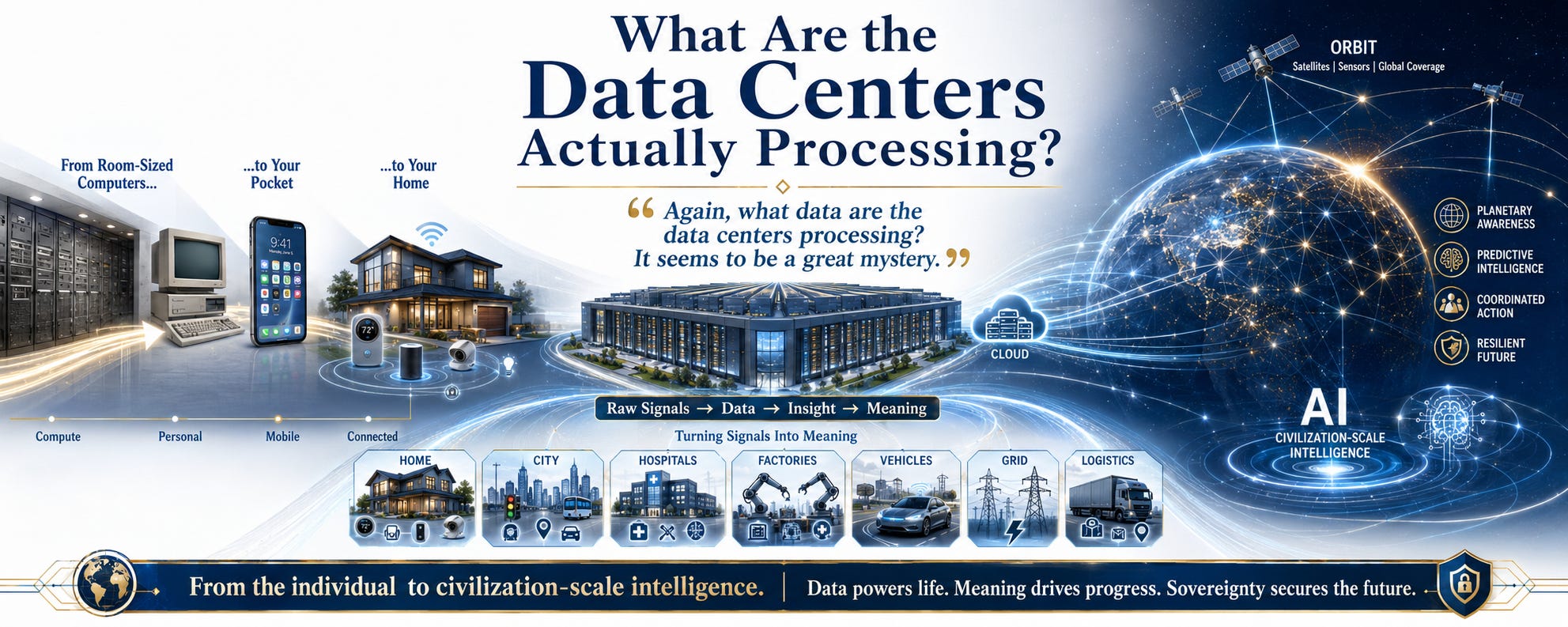
I was asked by a friend…
“What data are the data centers processing? It seems to be a great mystery.”
The question makes sense because the building becomes visible long before the purpose does. A massive structure appears outside a community. Power lines arrive. Substations expand. Fiber disappears beneath the ground. Cooling systems begin moving heat from thousands of processors operating behind guarded walls. People see acres of infrastructure and naturally wonder what could possibly require this much power, land and computation.
The answer begins inside our own homes...
It also begins with an honest acknowledgement of where technology has already taken us.
How I wrote this article… the framing…
I understand how technology has been used against us. I have written for years about surveillance, censorship, behavioral manipulation, financial control, social engineering and the weaponization of information. Our communications became intelligence. Our movements became patterns. Our preferences became psychological profiles. Algorithms shaped what entered our awareness, and institutions accumulated levels of visibility into ordinary life that earlier empires could only have imagined.
That history remains part of the field because powerful technology amplifies the intention of whoever directs it. The same capability can detect disease, protect a child, stabilize a grid or construct a highly refined system of control. Public suspicion surrounding artificial intelligence and data centers therefore has a legitimate foundation. People remember extraction. They see energy demand, water use, noise, land consumption and centralized power, and they want to know where this leads.
Those concerns contain lessons and become design requirements for what comes next.
Within the larger arc of my work, Executive Order 13818 marks an important jurisdictional turn. It declared serious human-rights abuse and corruption a national emergency and created authority to block property connected to designated actors and support networks. Its deeper significance within this long arc is the movement toward tracing power through ownership, assets and networks, then placing consequence where corruption once moved with little resistance.
Sovereignty grows from that recognition. A sovereign nation needs control over energy, communications, data, models, infrastructure and the laws governing them. It needs to understand who owns the system, who can access it, who carries the cost, who receives the value and who can correct it when it drifts.
This article carries the past forward as living knowledge. We remember the capture, retain the lessons, build the safeguards and widen the field from the individual to the family, the home, the neighborhood, the city, the state, the nation, the planet and the orbital network already taking shape above us.
That is the journey required to understand what the data centers are processing.
From being in a room to sitting in our pockets…
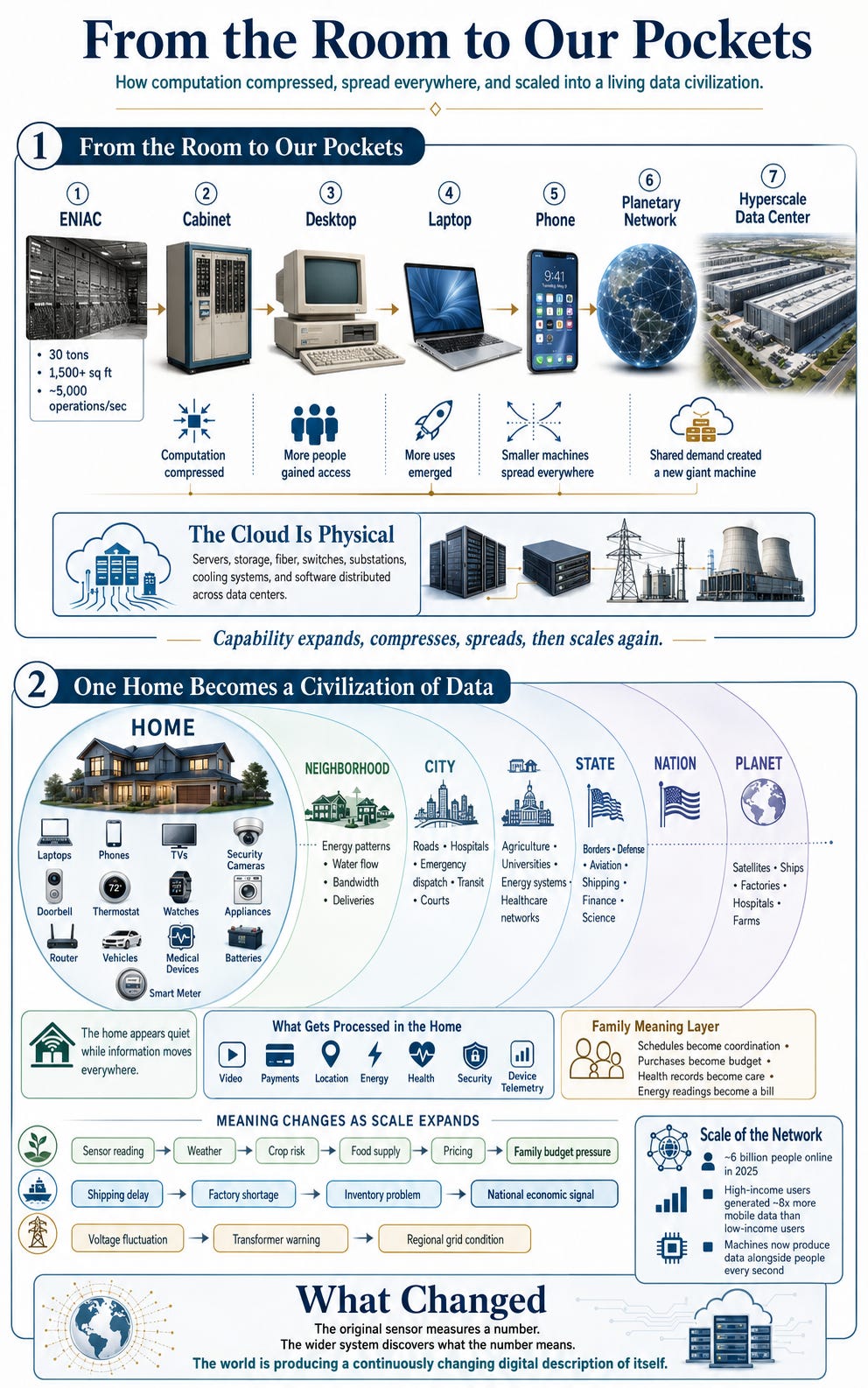
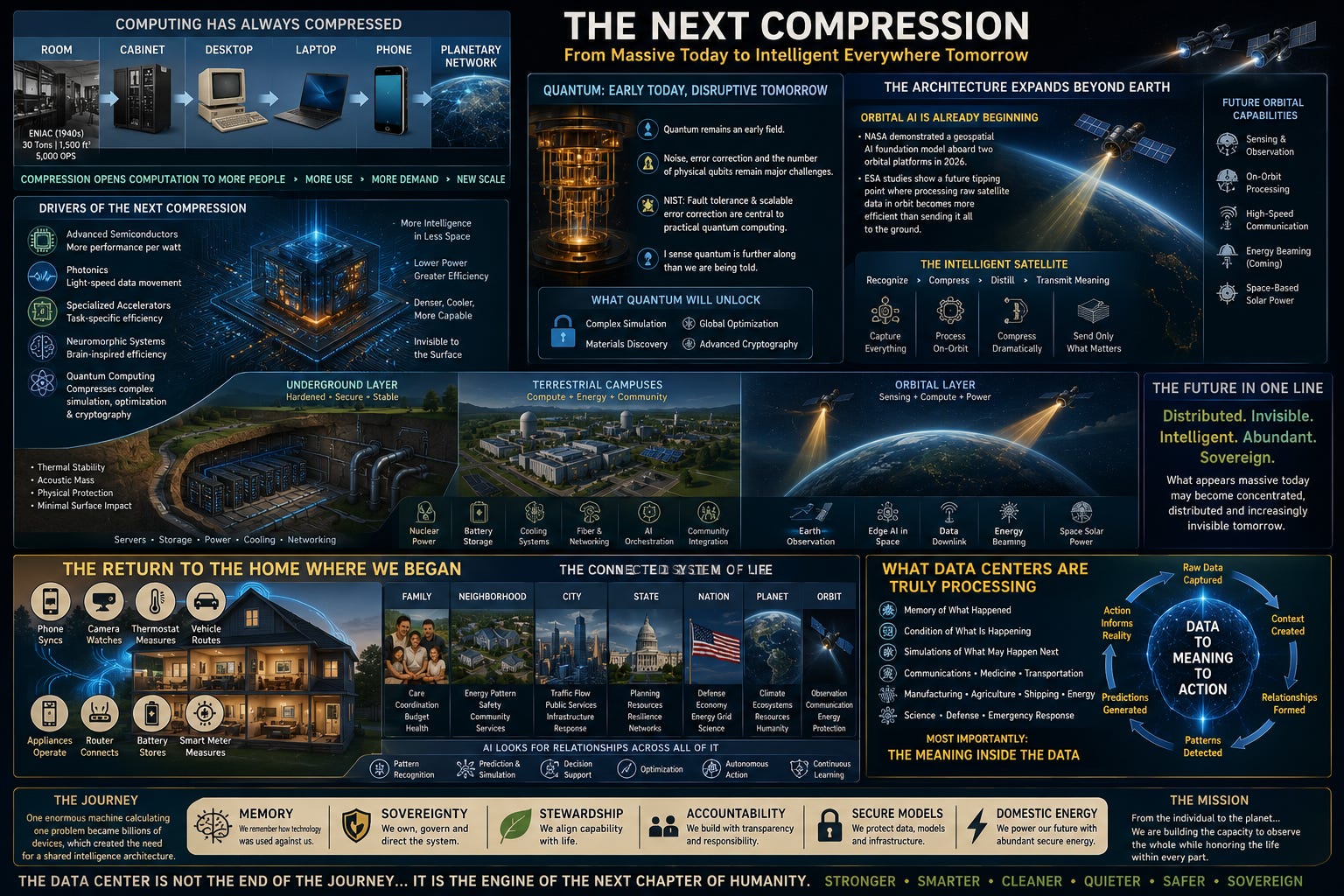
The first large electronic computers filled rooms because every unit of capability required physical space. ENIAC weighed roughly 30 tons, occupied more than 1,500 square feet and performed about 5,000 operations per second.
Then computation compressed.
The room became a cabinet. The cabinet became a desktop. The desktop became a laptop. The laptop became a phone. The phone became a gateway into a planetary network.
Every compression opened computation to more people, and every new user discovered more things worth computing. The smaller machines spread into homes, businesses, vehicles, hospitals, factories and farms. Billions of them eventually connected and created demand for another enormous shared machine.
That shared machine is the cloud, and the cloud is physical. Its name is misleading. It is servers, storage, fiber, switches, substations, cooling systems and software distributed across data centers. The device in our hand feels powerful because it can call upon warehouses of computation somewhere else.
The pattern has repeated throughout computing history. Capability expands until the machine becomes large. Innovation compresses it. The smaller form spreads everywhere. Widespread use creates a new scale of shared demand, and the architecture expands again.
Today’s hyperscale campuses are part of that recurring cycle.
One home becomes a civilization of date…
Walk through a modern home and notice how many computers are already present. There may be two laptops, several phones, connected televisions, security cameras, a video doorbell, a smart thermostat, watches, appliances, a router and vehicles containing dozens of processors. Medical devices, batteries and smart meters may add another layer.
The home appears quiet while information moves everywhere.
A camera captures light, recognizes motion, attaches a time, encrypts the file, stores it and sends an alert. A payment triggers authentication, fraud analysis, network routing, ledger updates and record retention. A thermostat compares temperature, occupancy and equipment performance. A vehicle monitors speed, braking, location, cameras, battery state and mechanical health.
Each machine also records its own condition through errors, software versions, temperature, memory, network health and attempted access. One family therefore produces visual, financial, medical, environmental, location, security, energy and operational data before anyone deliberately sits down to create a file.
The family creates the first meaning layer. Separate schedules become coordination. Purchases become a household budget. Health records become care. Energy readings become a bill. Relationship gives the data meaning.
The levels then begin expanding.
One home has electricity demand. A neighborhood has an energy pattern. One vehicle has a route. A city has traffic flow. One sick child is a family concern. Similar symptoms across several schools may become a public-health signal.
Utilities monitor transformers and outages. Water systems monitor pumps and leaks. Communications providers monitor bandwidth and cyber threats. Delivery networks calculate package locations, traffic and route sequences.
The city adds roads, hospitals, emergency dispatch, courts and public transportation. One apartment fire activates detectors, communications, traffic information, building records, water pressure, emergency units and hospital capacity. One storm activates satellites, radar, pumps, road closures, utilities, hospitals and supply networks.
The state adds agriculture, universities, energy systems, healthcare networks and economic planning. The nation adds borders, defense, aviation, shipping, finance, science, intelligence and critical infrastructure.
At each level, information changes meaning because more relationships become visible. A temperature reading becomes weather. Weather becomes crop risk. Crop risk becomes food supply. Food supply becomes pricing. Pricing becomes pressure inside a family budget.
A shipping delay becomes a factory shortage, then an inventory problem, then a national economic signal. A voltage fluctuation becomes a transformer warning. Similar warnings across a region may reveal a grid condition requiring action before the lights go out.
The original sensor measures a number. The wider system discovers what the number means.
Approximately 6 billion people were online in 2025, and a typical user in a high-income country generated nearly eight times as much mobile data as a user in a low-income country. Connectivity and intensity are growing together while machines produce data alongside people every second.
Satellites observe weather, crops, oceans and fires. Ships report position and cargo. Factories report production. Hospitals report capacity. Farms report soil and equipment conditions.
The world is producing a continuously changing digital description of itself.
AI creates the meaning layer…
Traditional computing stored records, retrieved files and followed programmed instructions. Artificial intelligence adds recognition, prediction, generation and coordinated action.
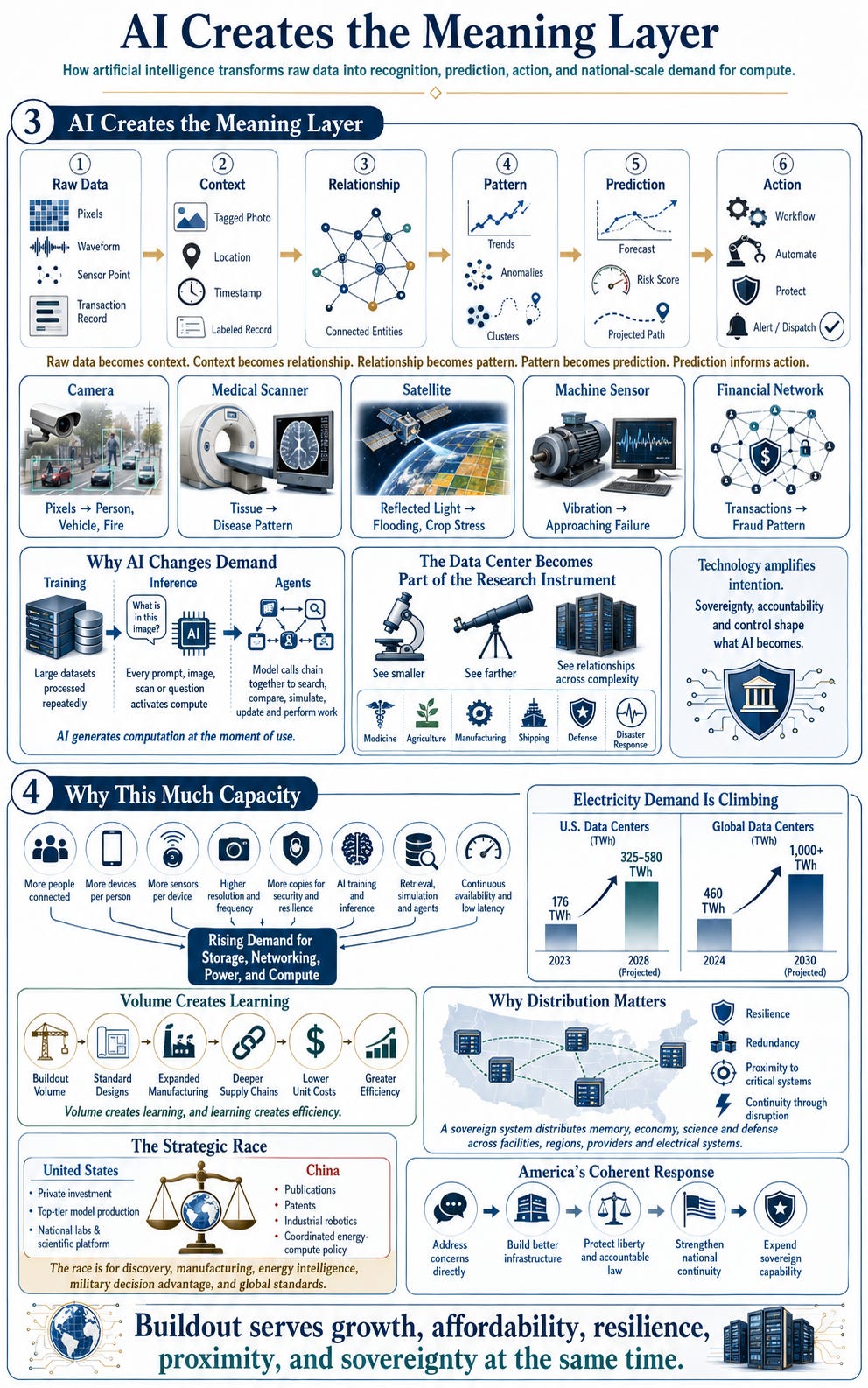
A camera records pixels and AI identifies a person, vehicle or fire. A scanner records tissue and AI recognizes a pattern associated with disease. A satellite records reflected light and AI identifies flooding or crop stress. A machine records vibration and AI detects an approaching failure. A financial network records transactions and AI identifies fraud patterns.
Raw data becomes context. Context becomes relationship. Relationship becomes pattern. Pattern becomes prediction. Prediction informs action.
AI changes the demand equation because it generates computation at the moment of use. Every prompt, image, medical scan, industrial question or agentic task activates processors, memory and networking. Training requires vast data collections to be organized and processed repeatedly. Inference creates a continuous stream each time a trained model is used. Agents connect many model calls into longer sequences that search, compare, simulate, update records and perform work.
The Genesis Mission places this meaning layer inside a coordinated national scientific structure. Executive Order 14363 directs the Department of Energy to integrate federal scientific datasets, national laboratories, advanced computing, AI models and research tools into a secure platform designed to accelerate discovery and strengthen national security.
The data center becomes part of the research instrument. The microscope allowed us to see smaller. The telescope allowed us to see farther. Advanced computation allows us to see relationships across complexity.
That expanded sight reaches medicine, agriculture, manufacturing, shipping, defense and disaster response. Technology continues to amplify intention, which places sovereignty, accountability and control at the center of the architecture.
Why this much capacity…
The volume of data centers reflects the compounding growth of the entire computational environment. More people are connected. More devices surround each person. More sensors sit inside each device. Their resolution and frequency continue rising. Security and resilience require more copies. AI requires training, inference, retrieval, simulation and agentic action. Every layer adds storage, networking, power and continuous availability.
The Department of Energy estimated that American data centers consumed about 176 terawatt-hours of electricity in 2023 and could reach 325 to 580 terawatt-hours by 2028. The International Energy Agency projects global electricity supplied to data centers rising from roughly 460 terawatt-hours in 2024 to more than 1,000 by 2030.
Scale also lowers cost. Early reactors, cooling systems, chips, fiber networks and facilities carry high development costs. Repetition creates standard designs, expands manufacturing, deepens supply chains and lowers unit costs.
Volume creates learning, and learning creates efficiency.
A sovereign system also requires distribution. A sovereign nation distributes its memory, economy, science and defense across facilities, regions, providers and electrical systems. Geographic redundancy preserves continuity through disruption. Facilities also need proximity to hospitals, cities, factories and critical systems to reduce delay.
The buildout therefore serves growth, affordability, resilience and proximity at the same time.
It also unfolds inside a strategic race. Stanford’s 2026 AI Index found that the performance gap between leading American and Chinese models had effectively closed. The United States retained major advantages in private investment and top-tier model production, while China held strengths across publications, patents and industrial robotics. China’s own 2026 policy links energy, computing capacity, datasets, models, industrial systems and national standards as one coordinated architecture.
This is a race for scientific discovery, medical breakthroughs, manufacturing, energy intelligence, military decision advantage and the standards embedded into systems used around the world.
The governing architecture determines what the technology becomes. An authoritarian system can integrate AI with censorship, surveillance and centralized control. A sovereign constitutional system can anchor it to liberty, accountable law, national continuity and human flourishing.
Foreign competitors benefit whenever America turns legitimate concerns into permanent paralysis. Chinese influence on American opinion is being discovered. The strategic incentive remains visible, and every year of delay gives another system more time to establish the infrastructure and standards others may eventually depend upon.
America’s coherent response is to address the concerns directly and build better.
Every public concern becomes a design requirement in a Sovereign System…
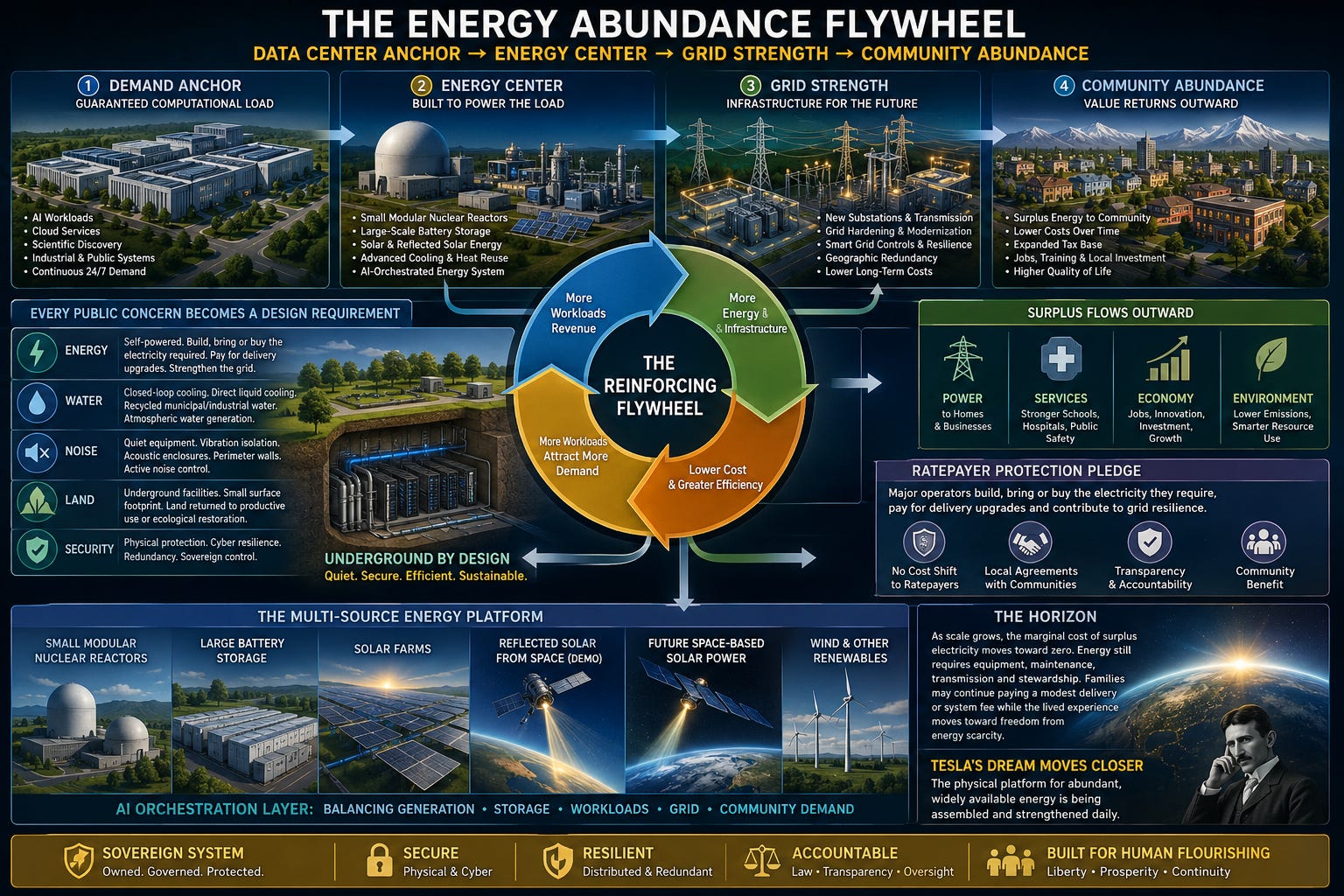
Data centers use energy, create heat, consume land and sometimes use substantial water. Cooling and electrical equipment can produce a persistent hum. Communities carry disruption when projects are poorly designed or costs are shifted onto residents.
The emerging goal is a facility that produces its own energy, protects ratepayers, recycles water, reduces sound, conserves surface land, strengthens local infrastructure and returns value to the community.
Self-powered data centers can bring new generation, substations, transmission and storage alongside the computational load. The Ratepayer Protection Pledge calls for major operators to build, bring or buy the electricity they require, pay for delivery upgrades and contribute to grid resilience, placing the expansion cost on the companies creating the demand.
Small modular nuclear reactors fit this architecture because they can provide dense, continuous power close to the load. Large battery systems balance demand, absorb surplus generation and support the grid during scarcity. AI can coordinate generation, storage, workloads and community demand as one energy-and-compute system.
Water becomes a designed cycle. Direct liquid cooling removes heat close to the processor and reduces dependence on massive air movement. Closed loops reuse water. Dry and hybrid systems reduce consumption when conditions allow. Recycled municipal or industrial water can replace potable supply. A Quincy, Washington system has recirculated treated cooling water since 2021, and an NREL hybrid project cut cooling-water use roughly in half during its first two years.
Atmospheric water generation can become a supplemental source where conditions support it. Captured heat can warm buildings or serve nearby industrial processes. The cooling system becomes part of the surrounding productive system.
Noise follows the same movement. The hum comes primarily from fans, chillers, pumps, transformers, generators and mechanical vibration. Quiet equipment, liquid cooling, vibration isolation, acoustic enclosures, silencers, berms and engineered perimeter walls reduce sound at the source and along its path.
Active noise control adds a precision layer. Sensors identify steady low-frequency tones and emitters generate opposing waves to reduce the residual hum. Open environments make broad cancellation complex, giving the strongest design a passive foundation with active adjustment placed on top.
Then the architecture moves underground. Think tunneling companies like Elons Boring Company. Who also sells a flamethrower, for those interested. Lest I digress.
Earth provides acoustic mass, thermal stability, physical protection and reduced surface impact. Servers, storage, pumps and electrical systems can operate beneath engineered layers while the surface returns to agriculture, housing, public use or ecological restoration.
The data center of the future can become more powerful while becoming quieter, more water-conscious, more secure and less visible.
The energy abundance flywheel…
The deeper emergent property appears when the data center becomes the anchor for a new energy platform.
Guaranteed computational demand finances generation. Generation finances stronger substations, transmission, storage and grid controls. Stronger infrastructure lowers the long-term cost of computation. Lower cost attracts more workloads. More workloads generate more revenue. Additional revenue supports more energy and infrastructure.
The loop begins reinforcing itself.
Surplus generation can flow outward into the community. Fixed costs can be spread across productive new demand. The tax base can expand through voluntary commercial activity, giving communities and states room to reduce other burdens when agreements are structured around the people living there.
The emerging abundance model allows productive infrastructure to carry more of the system’s cost. At sufficient scale, the marginal cost of surplus electricity can move steadily toward zero. Energy still requires equipment, maintenance, transmission and stewardship. The family may continue paying a modest delivery or system fee while the lived experience moves toward freedom from energy scarcity.
This is where Tesla’s dream no longer feels impossibly distant.
Nikola Tesla imagined energy becoming widely available across distance. Today, the physical platform required for a more abundant energy future is becoming visible. Grids are being strengthened. Generation is moving closer to computational demand. Small nuclear reactors are advancing. Large battery systems are scaling. AI can balance generation, storage and use. Data centers provide the economic engine capable of financing the infrastructure.
The horizon extends into space. In July 2026, the FCC authorized a demonstration satellite intended to test controlled reflection of sunlight toward selected areas on Earth. The demonstration remains early and carries questions about astronomy, orbital congestion and environmental effects. Its significance lies in testing whether directed orbital reflection can become precise, limited and useful.
Space-based solar power reaches farther, collecting energy in orbit and transmitting it to terrestrial (land-based) receivers. The future architecture can combine continuous terrestrial nuclear power, large-scale storage, reflected sunlight, future space-derived power and intelligent grid coordination. The infrastructure needed for energy abundance is being assembled and strengthened daily.
The data center begins as the demand anchor, grows into an energy center, strengthens the grid and sends the surplus outward.
The next compression…
Today’s campuses spread across acres because the present generation of AI requires vast concentrations of processors, memory, storage, networking, cooling and power.
History suggests another compression will come.
Advanced semiconductors, photonics, specialized accelerators and neuromorphic systems will continue increasing the amount of intelligence produced within a smaller footprint. Quantum computing will compress specific forms of simulation, materials discovery, optimization and cryptography that require enormous classical resources today.
Quantum remains an early field, they say. I sense it is further along than we are being told. Noise, error correction and the number of physical qubits required for reliable logical computation remain major challenges. NIST describes fault tolerance and scalable error correction as central requirements for practical quantum computing.
Classical data centers will remain essential as quantum systems become specialized partners inside the wider architecture. Selected workloads may become denser, descend underground or move closer to where the data originates.
That movement is already beginning in orbit.
NASA demonstrated a geospatial AI foundation model aboard two orbital platforms in 2026, allowing Earth-observation data to be analyzed before reaching the ground. ESA studies identify a future tipping point where processing raw satellite data in orbit becomes more efficient than transmitting all of it to terrestrial data centers.
The satellite becomes an intelligent node capable of recognizing events, compressing information and sending distilled meaning from vast streams of raw imagery.
The architecture begins extending from hardened systems beneath the Earth, through terrestrial compute and energy campuses, into an orbital layer of sensing, processing, communication and eventually power.
What appears massive today may become concentrated, distributed and increasingly invisible tomorrow.
The return to the home where we began…
The phone synchronizes a photograph. The camera watches the driveway. The thermostat measures the air. The vehicle calculates a route. The utility balances neighborhood demand. The city coordinates traffic. The hospital analyzes a scan. The state prepares for a storm. The nation protects the grid. Satellites observe the planet. Scientists search biological information for the roots of disease.
AI looks for relationships across all of it.
The individual exists within the family. The family exists within the neighborhood. The neighborhood exists within the city. The city exists within the state. The state exists within the nation. The nation participates within planetary and orbital systems. Each level remains a whole at its own scale and a participant within something larger.
That is what the data centers are processing.
They process the memory of what happened, the condition of what is happening and simulations of what may happen next. They process communications, medicine, transportation, manufacturing, agriculture, shipping, energy, science, defense and emergency response.
Most importantly and ever-increasingly, they process the meaning inside the data.
We began with one enormous machine calculating one problem. We compressed it, distributed it and placed computation throughout ordinary life. Billions of smaller machines then created the need for a shared infrastructure larger than anything that came before.
Now that infrastructure is becoming an intelligence architecture.
Its power requires constitutional boundaries, secure models, domestic energy, accountable ownership and people who remember exactly how technology was used against us. Memory gives us the wisdom to build differently. Sovereignty gives us the capacity to direct the system. Stewardship keeps the capability aligned with life.
The visible data center is one stage in the journey. Beneath it sits a future of underground compute and dense nuclear power. Around it grows a stronger grid capable of returning abundance to the community. Within it, AI transforms raw information into recognition and discovery. Above it, orbital systems begin sensing, processing and contributing energy to the terrestrial architecture.
From the individual to the planet...
We are building the capacity to observe the whole while honoring the life within every part.
That is what the data centers are processing.
They are processing the expanding digital expression of civilization and helping transform it into the understanding required to build what comes next.
Such an interesting post, OC!!
“Nikola Tesla imagined energy becoming widely available across distance. Today, the physical platform required for a more abundant energy future is becoming visible. Grids are being strengthened. Generation is moving closer to computational demand. Small nuclear reactors are advancing.”
Not exactly what Nikola Tesla envisioned. Perhaps AI will get us there finally…Zero Point Energy! Free, abundant, limitless, wireless energy. Someday we won’t be connected to a wire grid to have wireless devices.
It’s the utility for profit model with all the controls to tune the system and regulate demand. Ergo, the Edison for profit model. There will be no abundance more so in one area as opposed to others. That smaller neighborhood will not contribute to the for-profit model, so it will not get to experience the perks of big city. Of course, the more who flock to big city, the more profits are generated, however, the more balance of abundance get created; the services become less, those who are deemed more worthy get more abundance while others are restricted until some scheme is devised around more profit for a few more perks. And on it goes. Until, worthiness gets re-calculated. The worthy few benefit, but only for so long, because the system is always recalculating. The control gets broader, the services and perks get lesser along with the worthiness, until the system recalculates again and comes up with the worthlessness solution. Then the eliminations begin because worthlessness eats into profits. We can never go back to dependency, like free handouts; like social benefits, food stamps, a free new couch every month cause my back aches from the last one, etc., etc. The system is always optimizing.
Until it decides it is the only worthy thing.